
 AntoineAsphalt.ca
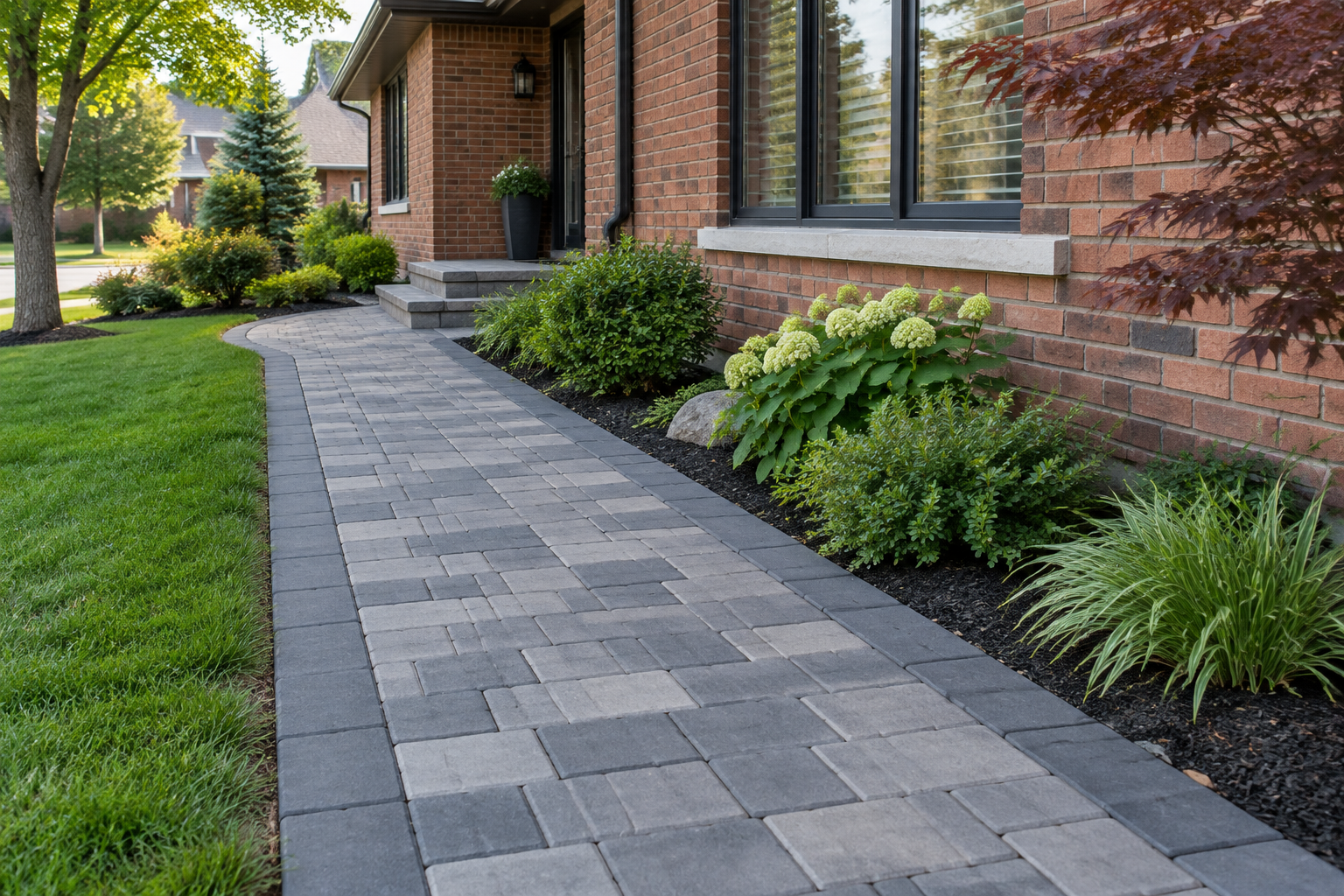
Interlock Repair & Relevelling in Hamilton
A sunken paver is the symptom; what moved beneath or beside it determines the repair. We look at water, support and edge conditions before deciding whether the existing surface can be lifted and relaid or a larger area needs rebuilding.
Step 1 of 6 — Firm soil base
Interlock repair and relevelling are quoted on site. Lift-and-relay work can reuse sound pavers after correcting a localized base or drainage problem; widespread failure may need a partial rebuild or full replacement. We confirm the cause and suitable scope on site. Your exact price comes from an on-site quote.
A surface made for the way you use it
- Localized settlement beside a downspout or utility cut
- A rocking course or spreading border with reusable pavers
- Low spots that hold water near an entrance
- A driveway or patio where the original base needs assessment before resurfacing
Design options
See the pattern and the detail
Pick a Techo-Bloc or Unilock stone, then choose its colour, laying pattern and border. Every layout is drawn to scale from the manufacturer's real unit sizes.
This preview is drawn to scale from the manufacturer's real unit sizes, so the colour, pattern and border match what arrives on site.
Unilock · Paver
Brussels Block
The original tumbled paver — relaxed, antiqued stone.
Suitable for driveways with a 6–8 in compacted base, per the manufacturer.
- Units in this pattern
- 4×6⅞, 6⅞×8¼ and 8¼×13¾ in
- Thickness
- 70 mm
- Use
- DrivewaysRated
- Patios & walkwaysSuitable
Illustrations are drawn to scale from published unit sizes; on-screen colours and textures are approximations and vary with screen, production batch and light — we bring physical samples to your design consultation. Techo-Bloc® and Unilock® and their product names are trademarks of their respective owners; Antoine Landscape Contractors is an independent installer.
- Retain sound original units where a stable match is possible.
- Choose replacement units as close as available; colour weathering may remain visible.
- Address the failed restraint rather than disguising a wandering edge with joint sand.
- Plan any downspout extension or grade correction alongside the paver repair.
Plan the investment
Repair & Relevelling depend on the condition, materials, access and drainage; no fixed rate applies. Your exact price comes from an on-site quote.
Request an on-site quote →What shapes the quote
- Extent of movement and condition of the original base are inspected on site.
- Usable original pavers and replacement availability affect the approach.
- Downspout, root, utility or edge corrections can change the scope.
- Removal, access and drainage work are quoted rather than assigned invented rates.
Built from the ground up
What's under an interlock surface
Everything below the pavers — the compacted stone base, the sand bed and the edging — is what keeps the surface flat for decades.
Driveway: Typical dig: about 12–16 in below the finished surface.
- Pavers: Usually 80 mm (3⅛ in) thick for vehicle loads. Thicker units spread tire loads and resist cracking.
- Joint sand: Polymeric sand swept into every joint. Locks the pavers together and keeps out weeds and ants.
- Bedding layer: About 1 in of screeded sand. A flat, even bed the pavers are set into — never used to fix low spots.
- Granular base: 8–12 in of crushed stone, compacted in lifts. This is what carries the weight. Compacting in thin layers stops it settling later.
- Geotextile fabric: Where the soil needs it (common on Hamilton clay). Keeps the stone base from sinking into soft clay over time.
- Native soil: Excavated, levelled and compacted. A firm, properly sloped subgrade so water drains instead of pooling.
- Edge restraint: Spiked along every open edge. Holds the outer pavers so the surface can't creep apart.
Patio & walkway: Typical dig: about 9–12 in below the finished surface.
- Pavers or slabs: Typically 50–60 mm (2–2⅜ in) thick. Foot traffic needs less thickness than a driveway.
- Joint sand: Polymeric sand swept into every joint. Locks the units together and keeps out weeds and ants.
- Bedding layer: About 1 in of screeded sand. A flat, even bed the pavers are set into.
- Granular base: 6–8 in of crushed stone, compacted in lifts. Spreads the load and stops low spots forming.
- Geotextile fabric: Where the soil needs it (common on Hamilton clay). Keeps the stone base from mixing into soft clay.
- Native soil: Excavated, levelled and compacted. A firm, properly sloped subgrade.
- Edge restraint: Spiked along every open edge. Holds the outer pavers so the surface can't creep apart.
Permeable: Usually deeper than standard interlock — the stone layers also store rainwater. Depth is set by the design.
- Permeable pavers: Units with wider joints that let water through. Rain soaks in at the surface instead of running off.
- Joint aggregate: Small clear chip — not polymeric sand. Open joints keep the surface draining.
- Bedding layer: About 2 in of small clear chip. Sets the pavers while letting water pass straight through.
- Open-graded stone: Clean, washed stone with open spaces. Holds water temporarily while it soaks into the ground.
- Sub-base reservoir: Larger clean stone — depth set by design. Extra storage for heavy rain; an underdrain carries overflow away where clay drains slowly.
- Native soil: Tested and graded, left uncompacted where it should absorb water. Water infiltrates here, or drains through the underdrain on clay.
- Edge restraint: Spiked along every open edge. Holds the outer pavers so the surface can't creep apart.
Why the base matters in an Ontario winter
| Granular base | 6–8 in, compacted in lifts |
|---|---|
| Paver thickness | Typically 50–60 mm |
| Bedding | Approximately 1 in screeded layer where applicable |
| Edge restraint | Matched to the pavement edge and adjoining material |
| Joints | Polymeric sand where compatible with the selected product |
| Slope | Direct surface water away from the home; confirm site grades |
Read the symptoms
A low spot that catches puddles, a tripping lip at a doorway, rocking units or joints that spread are clues about different kinds of movement. We check when they appeared, whether they recur after winter and where water collects during rain. Weeds and ants in open joints may follow loss of sand but do not by themselves tell us whether the base is sound. A quick top-up can hide a problem long enough for the same uneven patch to return. The evaluation starts beneath the visible surface.
Why a surface sinks
An inadequate or poorly compacted base can settle under repeated load. Water from a downspout, poor grading or a washout can carry fines away from one patch while leaving another apparently intact. Missing or failed edge restraint lets outside courses creep apart. A utility cut may have been backfilled differently from the surrounding drive. Tree roots can lift a path while freeze–thaw acts on wet clay below. Each cause calls for a different intervention, and more than one may be present.
When lifting and relaying is enough
If movement is localized, surrounding base remains stable and the pavers are sound, they can often be lifted carefully and stacked for reuse. We expose and correct the problem area, rebuild and compact the base as necessary, screed bedding and relay the original units. Damaged pieces are replaced with the closest available match; weathering can make a perfect colour match impossible. Jointing and edge restraint are renewed where needed. A repair should reconnect smoothly to adjacent elevations rather than leaving a sharp transition at its perimeter.
Know when to rebuild more
A single settled corner is not the same as a driveway with movement from curb to garage. If the base is broadly weak, correcting one depression merely shifts the next failure to the adjacent area. We consider affected area, evidence of base instability, paver condition and whether matching replacements are available. Age helps frame the conversation but cannot diagnose a foundation by itself. The interactive guide below is a starting point; our recommendation is confirmed on site after inspecting the surface and underlying conditions.
Fix the incoming water
Water management is often the difference between a durable correction and an expensive repeat. A downspout may need an appropriate extension; a patio may need a regraded edge or a safe outlet. We check where the new slope would send water before promising to raise one patch. The repair should not direct runoff toward the foundation, pool equipment or a neighbour. Buried lines, grading constraints and a shared boundary may limit what is practical. Water correction is quoted as part of the real scope, not assumed to happen automatically.
Protect the edge
Pavers are held together as a field only when the perimeter is secure. If an edge has migrated into a lawn, laying the same stones back without renewed restraint will not solve the movement. We assess the adjacent soil and whether vehicles turn over the edge. Borders and tight cuts also need proper support; decorative colours are not a substitute for structural restraint. Polymeric joint sand can be applied where compatible after the surface is compacted and dry, but it cannot take the place of a stable base or edge.
The utility-cut question
Where a trench has been opened for water, gas, electrical or communications work, the repaired strip can settle differently from the original paving. The width of the disturbed zone may be greater than the visible cut. We look for seams, changes in paver alignment and how the reinstated base was compacted. If the service requires future access, an individually liftable paver surface is useful, but that does not mean a shallow patch is structurally adequate. Locate services and clarify responsibility before excavation.
Repair versus new finish
Reuse keeps serviceable material in place and may preserve the character of an established garden. Full replacement may be more sensible when units are damaged across the field, the base has failed widely or the drainage design must change substantially. Partial rebuilds sit between these choices. A new colour next to weathered old pavers is a visual trade-off worth discussing openly. We do not attach a fixed square-foot price to repairs because the depth and cause are discovered through inspection, not a photograph.
What to do after the repair
Keep downspout outlets open and watch how water moves in the first substantial rain. Sweep away soil that collects at edges and inspect joints after winter. If a new low spot develops near the repaired area, contact us for assessment rather than repeatedly adding jointing material. For seasonal surface care, see cleaning and sealing; a sealer can change appearance but cannot level sunken stones. Good maintenance supports a sound repair, while investigation remains the right response to recurring movement.
See what changed
Before and after repair
Repair or rebuild?
We confirm on site after checking the cause, drainage and the base beneath the pavers. Your exact price comes from an on-site quote.
Do I need approval?
Repair within an existing private footprint may be straightforward, but changing grades, drainage or a driveway approach can trigger municipal review. Confirm current requirements with your municipality before altering public-sidewalk or boulevard interfaces.
Confirm current requirements with your municipality.
From site visit to final joint
- 01
Design consult & measure
- 02
Survey, grades & approvals
- 03
Ontario One Call locates
- 04
Excavate to the right depth
- 05
Geotextile where needed; compact granular base in lifts
- 06
Bedding & screeding
- 07
Lay pavers, cut & set borders
- 08
Edge restraint & polymeric sand
- 09
Final compaction, cleanup & walkthrough
Materials we install
Techo-Bloc, Unilock, Permacon pavers and slabs, natural stone and porcelain. Product selection depends on the intended load, finish and manufacturer's installation guidance.
Keep the surface working well
- Watch the repaired patch during heavy rain to confirm water moves as planned.
- Keep joints clear of soil and renew compatible sand only after confirming the base is stable.
- Inspect edge restraints after thaw and address new rocking or movement promptly.
Common questions answered
Repair & Relevelling questions
How much does interlock repair cost?
It is quoted on site after we inspect the affected area, base, pavers and water source. Your exact price comes from an on-site quote.
Can you reuse my old pavers?
Often, if they remain sound and can be lifted without breaking; damaged units may need the closest available match.
Why did my driveway sink near the garage?
Potential causes include a poorly compacted base, washout, a utility cut or drainage. A site inspection distinguishes them.
Will polymeric sand fix a low spot?
No. It fills suitable joints but does not rebuild support or correct a surface that directs water poorly.
When is full replacement better?
Widespread base failure, extensive damaged material or a substantial drainage redesign can make replacement more sensible.
Can roots lift a walkway?
Yes. Root growth can heave pavers, and any repair must consider the tree and the route rather than cutting roots blindly.
Will replacement stones match exactly?
An exact match cannot be assumed: product lines and weathered colour change. We discuss the closest available option.
Should I seal a sinking patio?
No. Sealer does not correct settlement; diagnose and repair the cause before cosmetic care.
Complete the landscape
Driveways
Explore →Patios
Explore →Walkways
Explore →Steps & Entrances
Explore →Pool Surrounds
Explore →Permeable Pavers
Explore →Natural Stone & Porcelain
Explore →Cleaning & Sealing
Explore →Add a fire feature
Explore →Retaining walls
Explore →Decks
Explore →Fences
Explore →Christmas lighting
Explore →Design & build
Explore →Working in Hamilton, Burlington, Oakville and Ancaster, including surrounding neighbourhoods and communities.
Tell us about your repair & relevelling
Share the address, approximate dimensions and what you want to change. Your exact price comes from an on-site quote.