
 AntoineAsphalt.ca
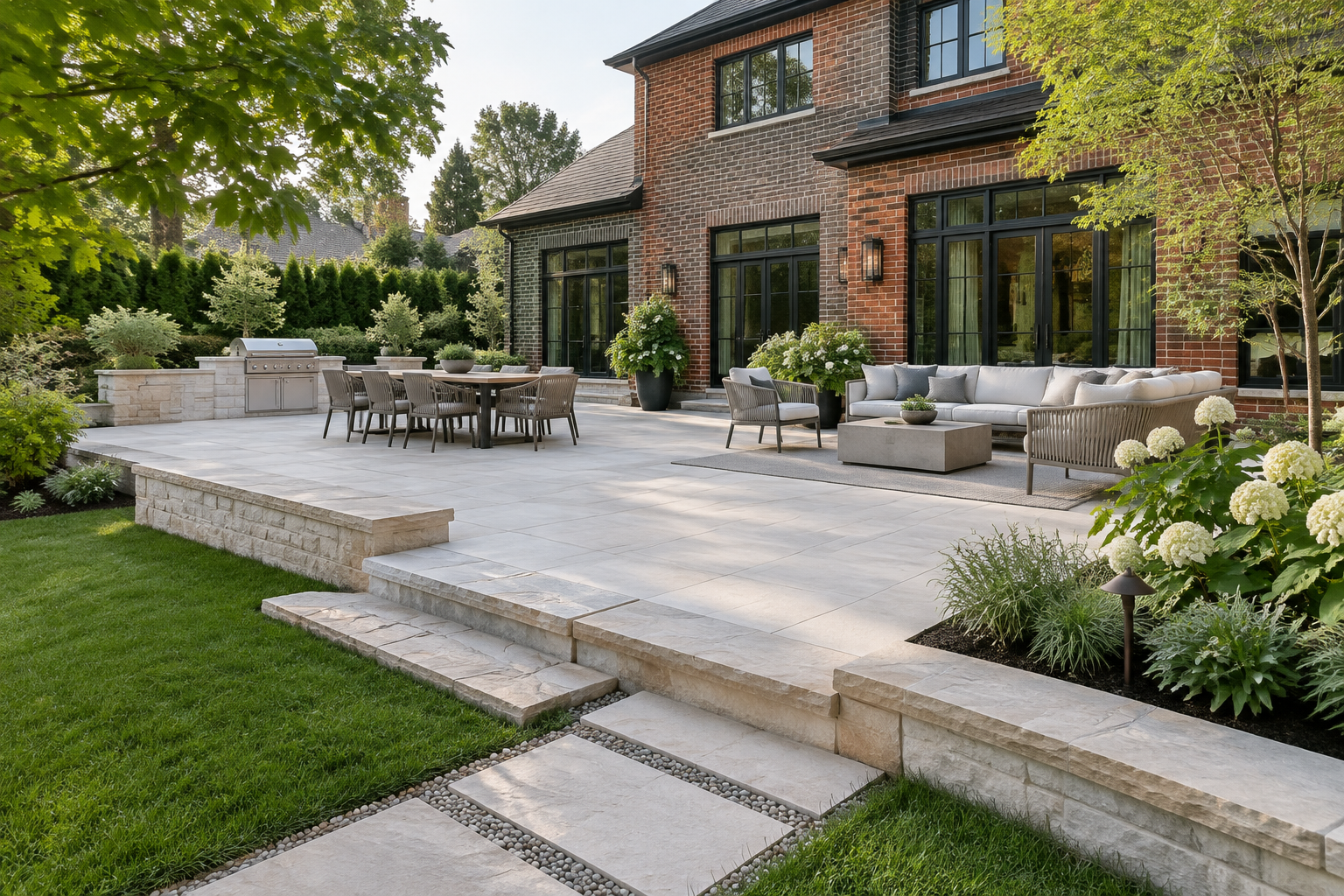
Natural Stone & Porcelain Patios in Hamilton
Natural stone and porcelain offer two very different ways to give an outdoor room a distinctive surface. One varies from piece to piece; the other offers a precise manufactured format. Both require the right product, support and edge treatment for their actual setting.
Step 1 of 6 — Firm soil base
Typical Ontario installed ranges (2026) for natural stone and porcelain are $35–$55 per sq ft; your exact price comes from an on-site quote. Material thickness, cuts, access, subgrade and the chosen assembly affect the site-specific scope.
A surface made for the way you use it
- A patio where material character is central to the design
- An entrance that needs coordinated treads and landings
- A pool surround where the exact product suits wet barefoot use
- A garden route connecting a stone terrace and planted edges
Design options
See the pattern and the detail
Pick a Techo-Bloc or Unilock stone, then choose its colour, laying pattern and border. Every layout is drawn to scale from the manufacturer's real unit sizes.
This preview is drawn to scale from the manufacturer's real unit sizes, so the colour, pattern and border match what arrives on site.
Unilock · Paver
Richcliff
Modular cut-flagstone look with varied textures.
Approved for driveways in the random bundle; the large rectangle is for patios and walkways.
- Units in this pattern
- 5⅞×8⅞, 8⅞×8⅞ and 8⅞×11⅞ in
- Thickness
- 60 mm
- Use
- DrivewaysRated
- Patios & walkwaysSuitable
Illustrations are drawn to scale from published unit sizes; on-screen colours and textures are approximations and vary with screen, production batch and light — we bring physical samples to your design consultation. Techo-Bloc® and Unilock® and their product names are trademarks of their respective owners; Antoine Landscape Contractors is an independent installer.
- Irregular flagstone follows the character of each piece, while dimensional cuts create calmer coursing.
- Limestone tones and surface finishes change visibly between dry shade and bright sun.
- Outdoor porcelain offers crisp repeated geometry; joint alignment and cuts deserve careful planning.
- A contrasting edge should clarify a step or garden transition rather than compete with the stone.
Plan the investment
$35–$55 per sq ft · Typical Ontario installed ranges (2026); your exact price comes from an on-site quote.
What shapes the quote
- Natural variation, thickness sorting and product format affect handling.
- Curves, steps, coping and edge cuts require site-specific detailing.
- Base or pedestal method depends on the product and substrate.
- Access, drainage and removal are assessed on site, not invented add-on rates.
Built from the ground up
What's under an interlock surface
Everything below the pavers — the compacted stone base, the sand bed and the edging — is what keeps the surface flat for decades.
Driveway: Typical dig: about 12–16 in below the finished surface.
- Pavers: Usually 80 mm (3⅛ in) thick for vehicle loads. Thicker units spread tire loads and resist cracking.
- Joint sand: Polymeric sand swept into every joint. Locks the pavers together and keeps out weeds and ants.
- Bedding layer: About 1 in of screeded sand. A flat, even bed the pavers are set into — never used to fix low spots.
- Granular base: 8–12 in of crushed stone, compacted in lifts. This is what carries the weight. Compacting in thin layers stops it settling later.
- Geotextile fabric: Where the soil needs it (common on Hamilton clay). Keeps the stone base from sinking into soft clay over time.
- Native soil: Excavated, levelled and compacted. A firm, properly sloped subgrade so water drains instead of pooling.
- Edge restraint: Spiked along every open edge. Holds the outer pavers so the surface can't creep apart.
Patio & walkway: Typical dig: about 9–12 in below the finished surface.
- Pavers or slabs: Typically 50–60 mm (2–2⅜ in) thick. Foot traffic needs less thickness than a driveway.
- Joint sand: Polymeric sand swept into every joint. Locks the units together and keeps out weeds and ants.
- Bedding layer: About 1 in of screeded sand. A flat, even bed the pavers are set into.
- Granular base: 6–8 in of crushed stone, compacted in lifts. Spreads the load and stops low spots forming.
- Geotextile fabric: Where the soil needs it (common on Hamilton clay). Keeps the stone base from mixing into soft clay.
- Native soil: Excavated, levelled and compacted. A firm, properly sloped subgrade.
- Edge restraint: Spiked along every open edge. Holds the outer pavers so the surface can't creep apart.
Permeable: Usually deeper than standard interlock — the stone layers also store rainwater. Depth is set by the design.
- Permeable pavers: Units with wider joints that let water through. Rain soaks in at the surface instead of running off.
- Joint aggregate: Small clear chip — not polymeric sand. Open joints keep the surface draining.
- Bedding layer: About 2 in of small clear chip. Sets the pavers while letting water pass straight through.
- Open-graded stone: Clean, washed stone with open spaces. Holds water temporarily while it soaks into the ground.
- Sub-base reservoir: Larger clean stone — depth set by design. Extra storage for heavy rain; an underdrain carries overflow away where clay drains slowly.
- Native soil: Tested and graded, left uncompacted where it should absorb water. Water infiltrates here, or drains through the underdrain on clay.
- Edge restraint: Spiked along every open edge. Holds the outer pavers so the surface can't creep apart.
Why the base matters in an Ontario winter
| Granular base | 6–8 in, compacted in lifts |
|---|---|
| Paver thickness | Typically 50–60 mm |
| Bedding | Approximately 1 in screeded layer where applicable |
| Edge restraint | Matched to the pavement edge and adjoining material |
| Joints | Polymeric sand where compatible with the selected product |
| Slope | Direct surface water away from the home; confirm site grades |
Stone has a natural vocabulary
Flagstone can be irregular, with hand-selected pieces making a gently varied surface, or dimensional, with deliberate courses and straight edges. Limestone and other natural stones vary in veining, tone and texture even within the same order. Thickness may differ from piece to piece, changing how bedding is prepared. Selecting a sample helps establish a direction, but it should not be interpreted as a promise that every installed slab looks identical. We plan the pattern around useful walking widths, furniture and the building's geometry.
Porcelain is an outdoor product choice
Outdoor porcelain pavers are often about 2 cm thick, dense and low absorption, making them appealing where a precise finish and stain resistance matter. Not every porcelain tile belongs outside. Select a frost-resistant, outdoor-rated product with suitable slip resistance according to its manufacturer's specifications. Compare a full-size piece in sun, shade and wet conditions rather than judging a small indoor sample. The installation method, edge support and intended loads must match the specific paver, not just the word porcelain on a box.
Choose an assembly, not a shortcut
A suitable stone or porcelain surface may be laid over a properly compacted granular foundation and appropriate bedding, when product and site support that method. Pedestal systems over suitable existing structures are another application-specific option, not a universal replacement for a prepared patio base. The substrate, edge confinement, drainage, heights at doors and maker's installation directions decide what is appropriate. We will not recommend placing a new surface over a moving slab merely because demolition is inconvenient. Each layer needs to work as part of the assembly.
Thickness and cutting shape the result
Natural flagstone thickness differences take sorting and careful setting; porcelain's precise dimensions demand equally precise cuts and supported edges. Curves, drains, stair returns and corners can create narrow pieces that are vulnerable or visually distracting. Setting out a full course before the first cut helps avoid awkward slivers beside a door or coping. Where a patio meets a planting bed, the restraint should hold the edge without turning the garden into a rigid frame. Cutting and waste are considered in the quote after dimensions are measured.
Heat and colour near seating
Pale paving may absorb less solar heat than very dark material, but barefoot comfort also depends on composition, texture, exposure and shade. See the actual finish outdoors at the time of day the terrace will be used. A dark border can beautifully define a large patio yet feel too strong across an entire sunny pool deck. Natural stone may show more colour variation when wet, while porcelain can give a more uniform field. Samples should be viewed alongside brick, deck boards, coping and planted colour.
Pool and entrance details
A pool setting asks for appropriate wet traction, barefoot feel, chemical compatibility and a coping profile agreed with the pool installer. At a front entrance, tread geometry, landing drainage and any applicable railing requirements take priority over a matching stone face. Coordinated treads can visually connect a terrace to steps, but the step assembly may need different support from the adjacent flat paving. Confirm pool enclosure rules with the municipality and the material maker's product suitability before committing to an appearance.
Vehicle areas are a separate question
Natural stone and porcelain patios do not automatically translate to a driveway. Point loads, steering forces and winter clearing create different demands. Unless the exact product and assembly are rated for vehicles, we generally recommend a purpose-selected interlock driveway instead. A pedestrian border beside the driveway can share colour without being asked to carry tires. If a homeowner wants a continuous front-yard look, we plan the different load sections and the transition between them rather than promising that one slab suits every part of the property.
Cleaning and sealing depend on material
Some natural stones may benefit from a compatible sealer, while others are best maintained without a changed finish; follow the stone and sealer makers' instructions. Outdoor porcelain often cleans differently from porous stone and may not need the same sealing treatment. Test any cleaner or stain treatment in a discreet area first, particularly around sensitive limestone. Use only jointing and de-icers compatible with the chosen product. A surface that shifts or holds water needs the supporting cause repaired before cosmetic cleaning or sealing.
Make the surrounding landscape coherent
A stone patio can meet a timber deck, garden retaining wall or interlock path without repeating every material. Start with the walking route from the house and establish where levels and thresholds change. Lighting at a step or low wall can give a natural stone edge definition at night. If a pool is planned later, reserve access, drainage routes and space for enclosure posts before the final paving pattern is fixed. This is a material choice that works best when the whole outdoor room has been considered.
Do I need approval?
Ground-level patio paving is subject to site-specific grading, conservation and coverage considerations; raised platforms, steps, pool enclosures or structures can bring further requirements. Confirm current requirements with your municipality and the selected product maker.
Confirm current requirements with your municipality.
From site visit to final joint
- 01
Design consult & measure
- 02
Survey, grades & approvals
- 03
Ontario One Call locates
- 04
Excavate to the right depth
- 05
Geotextile where needed; compact granular base in lifts
- 06
Bedding & screeding
- 07
Lay pavers, cut & set borders
- 08
Edge restraint & polymeric sand
- 09
Final compaction, cleanup & walkthrough
Materials we install
Techo-Bloc, Unilock, Permacon pavers and slabs, natural stone and porcelain. Product selection depends on the intended load, finish and manufacturer's installation guidance.
Keep the surface working well
- Clean stains promptly with product-compatible methods and test cleaners on a discreet area.
- Follow the exact stone or porcelain maker's sealing, de-icer and joint-care directions.
- Inspect edges, steps and drainage after winter; correct movement before recoating.
Common questions answered
Natural Stone & Porcelain questions
What is the natural stone and porcelain installed range?
Typical Ontario installed ranges (2026) are $35–$55 per sq ft; your exact price comes from an on-site quote.
Is outdoor porcelain the same as indoor tile?
No. Specify a frost-resistant, outdoor-rated product with appropriate surface traction and installation method per its maker.
Are porcelain pavers always 2 cm?
They are often around 2 cm, but product specifications vary; choose the assembly for the actual thickness and intended use.
Will flagstone slabs all look alike?
No. Natural variation in tone, texture and thickness is part of the material; dimensional cuts give a more ordered layout.
Can porcelain sit on pedestals?
Only over a suitable supporting surface using a system and product intended for that application.
Is limestone good around a pool?
Confirm the selected finish's wet traction, bare-foot comfort, chemical compatibility and coping detail with the maker and pool installer.
Can these pavers go on a driveway?
Generally not our first recommendation unless the exact product and support system are rated for vehicle loads.
Should I seal a stone patio?
It depends on stone and desired appearance. Follow the material and sealer manufacturers' instructions rather than a universal schedule.
Complete the landscape
Driveways
Explore →Patios
Explore →Walkways
Explore →Steps & Entrances
Explore →Pool Surrounds
Explore →Permeable Pavers
Explore →Repair & Relevelling
Explore →Cleaning & Sealing
Explore →Add a fire feature
Explore →Retaining walls
Explore →Decks
Explore →Fences
Explore →Christmas lighting
Explore →Design & build
Explore →Working in Hamilton, Burlington, Oakville and Ancaster, including surrounding neighbourhoods and communities.
Tell us about your natural stone & porcelain
Share the address, approximate dimensions and what you want to change. Your exact price comes from an on-site quote.