
Opening
Pools open late April to mid-May (Earthworks, Sep 2026). A full spring opening runs $349 in Halton (Earthworks) and $395 before HST in Oakville (Total Tech Pools, Aug 2026).
Planting & finishing
Design & Build
One plan for the whole yard, from the first layout to the finished build.
Go to Design & BuildPool Installation
Fibreglass, vinyl liner and concrete pools, with the patio, fence and landscaping around them.
Pool Installation overviewFire Features
Gas fire pits, wood fire pits and outdoor fireplaces, planned around your city's burn rules.
Fire Features overviewWater Features
Ponds, pondless waterfalls and fountains, with the depth, power and winter care planned first.
Water Features overviewRetaining Walls
Armour stone, interlocking block and natural stone walls, built to hold the grade.
Retaining Walls overviewPrepare the site
 AntoineAsphalt.ca
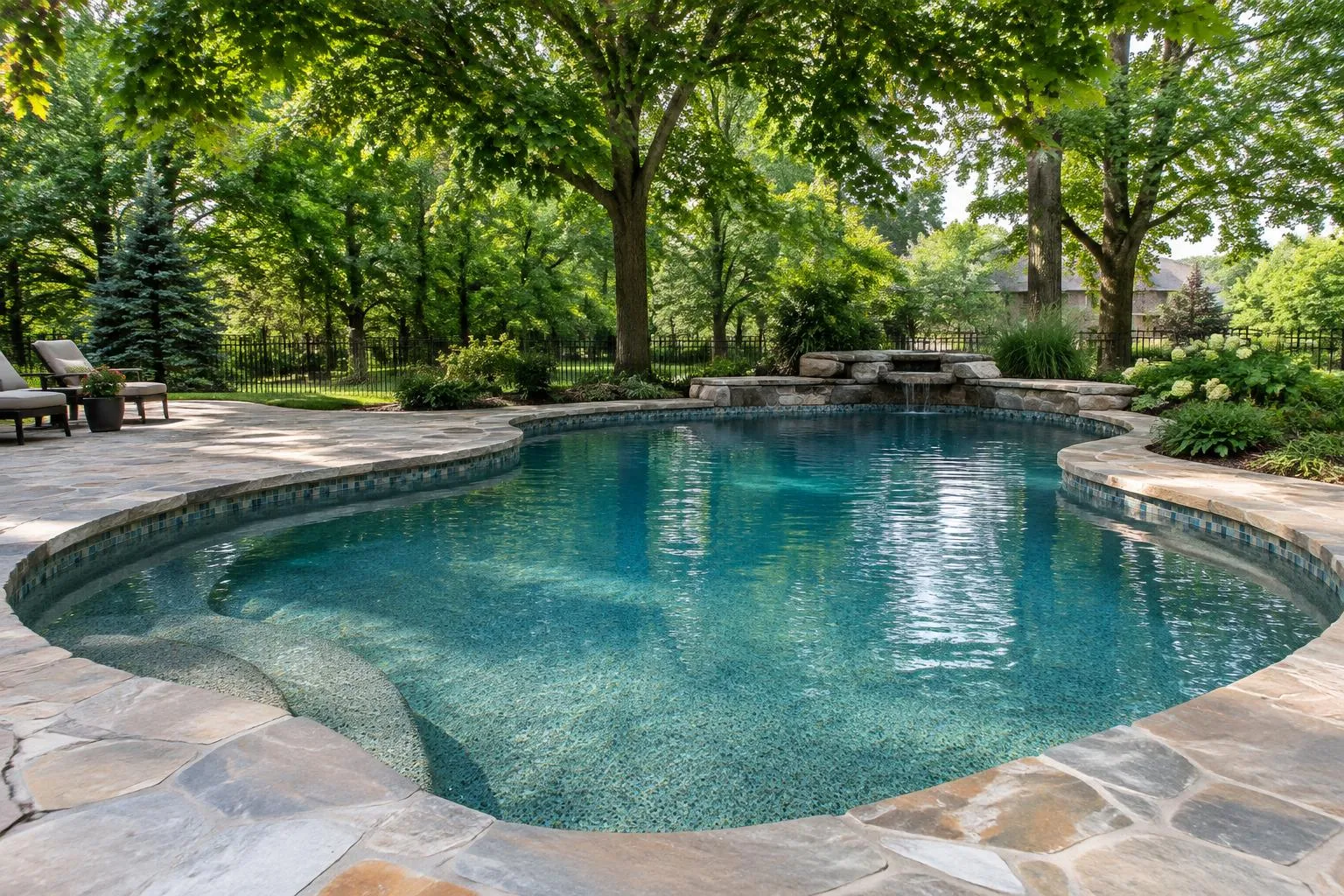
Concrete pools · Hamilton, Burlington & Oakville
A concrete pool is sprayed on site over a steel cage, as gunite (dry mix, water added at the nozzle) or shotcrete (wet mix), and can take any shape. Antoine installs concrete pools and builds the landscape around them, as one project with one point of contact.
Step 7 of 7 — Fill
Concrete pools have a typical market range of $100,000–$250,000 installed (HomeStars Ontario, Aug 2026; MoneySense, Jun 2024). They are fully custom and take 2–3 months to build before permits and inspections (Orange Pools, Jul 2026). Expect an acid wash every 3–5 years and a replaster every 10–12 years at $12,000–$15,000 (MoneySense, Jun 2024).
Fit
Step by step
How to read this: A side view of the pool in the ground. Step through to watch it being built, layer by layer.
The hole is dug to the custom shape and depth, after a free Ontario One Call locate.
#3–#4 bars are tied at 8–12 in on centre, held for 3 in of cover (EngineerFix, Dec 2025).
Gunite or shotcrete is sprayed over the cage: typically 6–8 in walls and a floor of at least 9 in (EngineerFix, Dec 2025).
The shell cures to a minimum of 4,000 psi (28 MPa) and should be essentially watertight before plaster (American Shotcrete Association).
Waterline tile and coping go on; these and the mortar beds are the freeze-thaw weak points (Shotcrete magazine, Q2 2025).
Plaster, quartz, pebble or tile is applied. Plaster is the cheapest and most porous.
Water goes in once the permanent enclosure has passed inspection, as all three cities require.
Step 1 of 7 — Excavate
Industry practice; many details from US manufacturers and trade bodies.
Layers
How to read this: A side view of the pool wall and floor, cut in half. Tap a layer to read what it is; the numbered list says the same thing.
Based on industry practice; not Ontario code. Not to scale.
Concrete specifics
How to read this: Two ways to spray a concrete pool shell. Compare where the water gets mixed in.
Both are sprayed over a rebar cage. The American Shotcrete Association calls for at least 4,000 psi (28 MPa) and a shell essentially watertight before plaster.
How to read this: A side view of a concrete pool shell, cut in half. The numbers match the list of typical sizes under it.
How to read this: Each square shows roughly what a finish looks like; the note under it says how it differs.
The cheapest and most porous finish.
Less porous than plaster; ask for current pricing.
Less porous than plaster; ask for current pricing.
Less porous than plaster; ask for current pricing.
How to read this: A close-up of the pool edge, cut in half. The numbered dots are the spots that freeze-thaw damages first.
Waterline tile, where wet-dry and freeze-thaw cycles meet.
The exposed cap over the pool edge.
The joint under the coping that holds it to the shell.
The tile line, coping and mortar beds are the freeze-thaw weak points; air entrainment and a lower water-cement ratio help (Shotcrete magazine, Q2 2025).
Typical market ranges
How to read this: Each bar shows one source's typical market range for this pool type, from low to high, on a scale of $0 to $250k. These are market figures, not our prices.
Installed cost, CAD (typical market range per source)
Illustrative estimate, not a quote.
Typical market ranges from the named source and date. Your exact price comes from an on-site quote.
How to read this: Pick your pool and extras. Each line shows a typical market range from a named source; the total adds up the low ends and the high ends. Not our prices.
Typical all-in market range
$124,500–$300,000
| Line item | Typical market range | Source |
|---|---|---|
| Concrete (gunite / shotcrete) pool, installed | $100,000–$250,000 | HomeStars Ontario inground pool cost guide, Aug 2026 |
| Interlock pool deck (600 sq ft) ($25–$45 per sq ft) | $15,000–$27,000 | Allen Landscaping, Mar 2026 |
| Pool fence | $4,000–$12,000 | Devine Image, Apr 2026 |
| Heat pump | $2,000–$6,000 | HomeStars Ontario inground pool cost guide, Aug 2026 |
| Standard safety cover | $3,500–$5,000 | Boulder Design, Feb 2026 |
| All-in total | $124,500–$300,000 | |
Typical market ranges from the named source and date. Your exact price comes from an on-site quote. Spoil haul-away, where needed, runs 200–400 cubic yards at $40–$80 per yard (Orange Pools, Jul 2026).
Cost of ownership
How to read this: Each line shows the running total a pool type could cost to own, year by year. Lower is cheaper. Change the years or the liner interval to update it.
Up: total cost to own, CAD (k = thousand dollars). Across: years owned.
Illustrative estimate, not a quote.
| Pool type | 10-year total | 25-year total |
|---|---|---|
| Fibreglass | $110,500 | $152,500 |
| Vinyl liner | $108,000 | $143,500 |
| Concrete | $204,000 | $276,500 |
Illustrative estimate, not a quote. Assumptions:
Closing and freeze-thaw
Year by year
Pools open late April to mid-May (Earthworks, Sep 2026). A full spring opening runs $349 in Halton (Earthworks) and $395 before HST in Oakville (Total Tech Pools, Aug 2026).
Seasonal running cost up to $2,500, including about $695 in chemicals (MoneySense, Jun 2024).
Close in October (Sima Canada): lower the water without draining, blow out the lines, add antifreeze and fit a tight cover.
Acid wash every 3–5 years (about $2,000); replaster every 10–12 years at $12,000–$15,000 (MoneySense, Jun 2024).
By-laws
Fence height: 1.5 m (2.0 m max per checklist)
Pool setback: 1.25 m from any lot line to the water's edge; not in the required front yard (Zoning By-law 05-200 s. 4.11)
Permit route: Enclosure Permit, Building Division (905-546-2720); owner signs the Oct 2025 checklist
Fence height: 1.2 m wood or 38 mm chain link; 1.5 m wrought iron; 1.8 m for 50 mm chain link; 2.0 m max
Pool setback: 1.5 m from lot or street line, measured from the inside wall; lots under 12 m wide: rear yard only
Permit route: Online Combined Residential Swimming Pool Application (zoning + forestry + enclosure); 4–6 weeks; needs an Ontario Land Surveyor survey and arborist report or tree declaration; incomplete applications not accepted
Fence height: 1.20 m
Pool setback: 1.5 m rear and interior side; 3.5 m flankage (corner lot street side); not in the front yard; max 1.5 m above grade; measured to the water's edge (Zoning 2014-014 s. 4.16.1; RL amendments 2026-088 adopted Jun 15, 2026 may change details)
Permit route: Development Engineering Permit, online; 5-day pre-screen, then 6–8 weeks
Ancaster, Dundas, Stoney Creek and Waterdown/Flamborough follow Hamilton's pool enclosure by-law. Full city rules comparison → Confirm current rules with your municipality before building.
Other options
One plan
Coping and pool decks on a prepared base.
Plan together →Enclosures planned around your city's rules.
Plan together →Level a sloped yard for the pool and deck.
Plan together →Raised decks and stairs down to the pool.
Plan together →A gas fire pit or outdoor fireplace on the pool patio.
Plan together →See pond rules: a deep pond can count as a pool.
Plan together →Budgets, season, rules and safety for all three types.
Plan together →Straight answers
HomeStars' Ontario guide (Aug 2026) and MoneySense (Jun 2024) both put installed concrete pools at $100,000–$250,000. Hamilton's Devine Image (Apr 2026) reports $120,000–$200,000 and up. Concrete is the most expensive of the three types. These are typical market ranges; your exact price comes from an on-site quote.
Both are concrete sprayed over a rebar cage. Gunite is a dry mix with water added at the nozzle; shotcrete is a wet mix delivered ready to spray. Either way the American Shotcrete Association calls for a minimum of 4,000 psi (28 MPa) and a shell essentially watertight before plaster.
Orange Pools (Jul 2026) says a concrete pool takes 2–3 months to build before permits and inspections, the longest of the three types. Concrete projects are usually swim-ready in July or later even when booked in the fall, compared with late May to June for fibreglass and vinyl liner.
MoneySense (Jun 2024) says concrete pools are replastered every 10–12 years at $12,000–$15,000, with an acid wash every 3–5 years at about $2,000. Those recurring surface costs are why concrete has the highest long-term cost in our illustrative 25-year comparison.
The common interior finishes are plaster, quartz, pebble and tile. Plaster is the cheapest and the most porous. Quartz, pebble and tile are less porous than plaster. The finish goes on after the shell has cured and the tile line and coping are set, and it is the surface that gets renewed over the pool's life; ask for current pricing.
The tile line, coping and mortar beds are the freeze-thaw weak points, according to Shotcrete magazine (Q2 2025). Air entrainment and a lower water-cement ratio help. Proper closing, with water kept below the tile line rather than drained, matters too.
Plaster is the most porous pool surface, and MoneySense (Jun 2024) estimates seasonal chemical costs of $695 for concrete pools, compared with $475 for vinyl liner and $325 for fibreglass. Total seasonal running cost for concrete is up to $2,500, the highest of the three types.
Yes. Because a concrete pool is sprayed on site over a rebar cage, it isn't limited by a factory mould or highway transport limits the way a fibreglass shell is. That makes concrete the usual choice for freeform shapes, unusual depths and large or awkward lots.
Start with the yard
Tell us your city, timing and side-yard access. We'll arrange a free on-site consultation.