
 AntoineAsphalt.ca
Can You Lay Pavers Over a Concrete Patio, Porch or Steps?
Quick answer
Yes, but only if the concrete is in excellent shape: no heaving, no rocking sections, no wide cracks, and sloped away from the house at least 1 inch per 8 feet. Unilock says poor drainage is the most common risk, so flat slabs need drain holes and a thin, free-draining bedding layer. If the slab moves or holds water, remove it and build a proper compacted stone base.
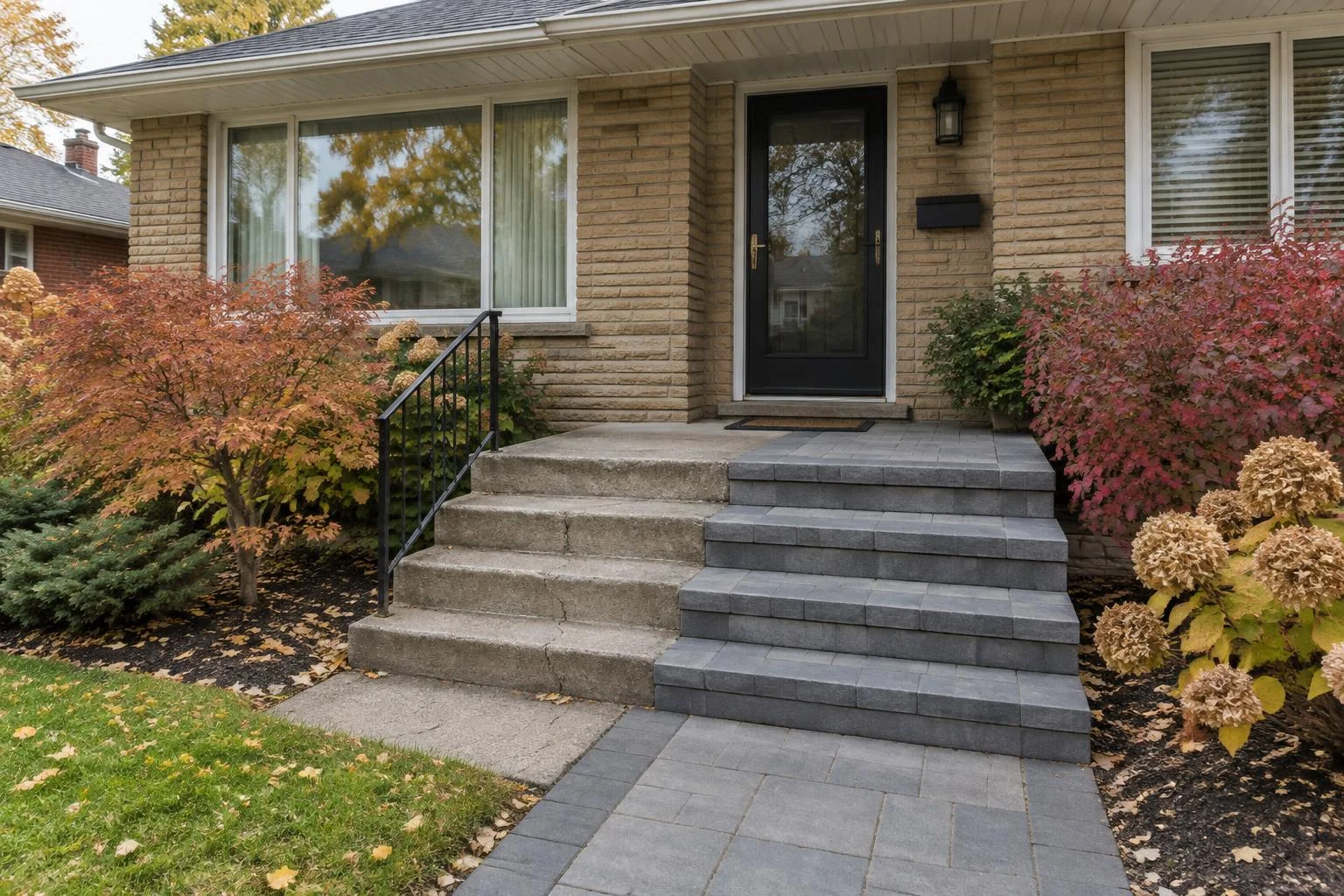
When can pavers go over existing concrete?
Unilock says an overlay works only when the concrete is "structurally sound with no major cracks or active movement." Check that:
- The slab is solid. Hairline cracks are fine.
- It slopes away from the house at least 1 inch for every 8 feet.
- Water can drain off it or through it.
When should the concrete come out instead?
Remove the slab and rebuild if you see:
- Heaving or sections that rock when you step on them.
- Wide cracks or gaps.
- A slope toward the house.
A rebuild uses a compacted stone base. Unilock calls for about 6 inches of road base under patios and walkways, 10 to 12 inches under driveways, and 1 inch of coarse bedding sand on top. Unilock does not recommend laying pavers right on dirt, because freeze-thaw can shift them.
How are pavers installed over a slab?
- Thin bedding. Unilock uses a 1-inch layer of bedding sand. A McGill University spec uses about 20 mm of bedding over a slab.
- Drainage. Drill drain holes in flat slabs and use a free-draining bedding.
- Edging. Fasten the edge restraint to the slab mechanically, so pavers can't creep.
Will pavers over concrete raise the height at my door or garage?
Yes. The new surface sits higher by the paver thickness plus the bedding. Check every door, threshold and step before you choose a paver. Unilock says: "If adding height creates clearance issues, consider thinner individual pavers."
Can concrete front steps or a porch be covered with pavers, stone or porcelain?
Yes, if the concrete underneath is sound. Unilock publishes contractor details for:
- porch and step overlays with pavers
- porch or step overlays with natural stone or porcelain
- porcelain on a modified mortar bed
- natural stone over smooth concrete
If a porch or landing is more than 600 mm (about 2 feet) above the ground, the Ontario Building Code requires a guard (railing), per OBC 9.8.8.1 as cited in a Town of Erin guide.
Overlay check
This is a screening tool, not an assessment. Based on Unilock guidance.
- Likely needs removal and a new compacted base.
- Overlay may work, but plan for drain holes and a free-draining bedding.
- Your slab may be a good overlay candidate. Have it checked in person.
- Ask about thinner pavers to keep door clearance.
Heaving, wide cracks or a slope toward the house indicate removal. A sound, sloped slab with standing water needs drainage. Raised door clearance requires checking thinner pavers.
Frequently asked questions
Can you put pavers over cracked concrete?
Hairline cracks are fine. Wide cracks, heaving or rocking sections mean the slab should come out and be replaced with a stone base.
Will pavers over concrete raise the height at my door?
Yes, by the paver plus the bedding. Unilock suggests thinner pavers where clearance is tight.
Is it cheaper to overlay than to remove the concrete?
We found no reliable Ontario price comparison. An overlay skips removal and a new base, but only works on a sound slab. Get both options quoted.
Do pavers over concrete need drainage?
Yes. Unilock calls poor drainage the most common risk. Flat slabs need drain holes and a free-draining bedding.
Related guides & services
Thinking about covering tired concrete steps or a patio? See our steps and entrances page and ask us to look at your slab.
Every slab is different. Have concrete checked in person before choosing an overlay, and confirm guard requirements for raised areas with your building department.
Ask about your project
Contact Antoine Landscape Contractors at (647) 459-7775 or share your project details below.