
 AntoineAsphalt.ca
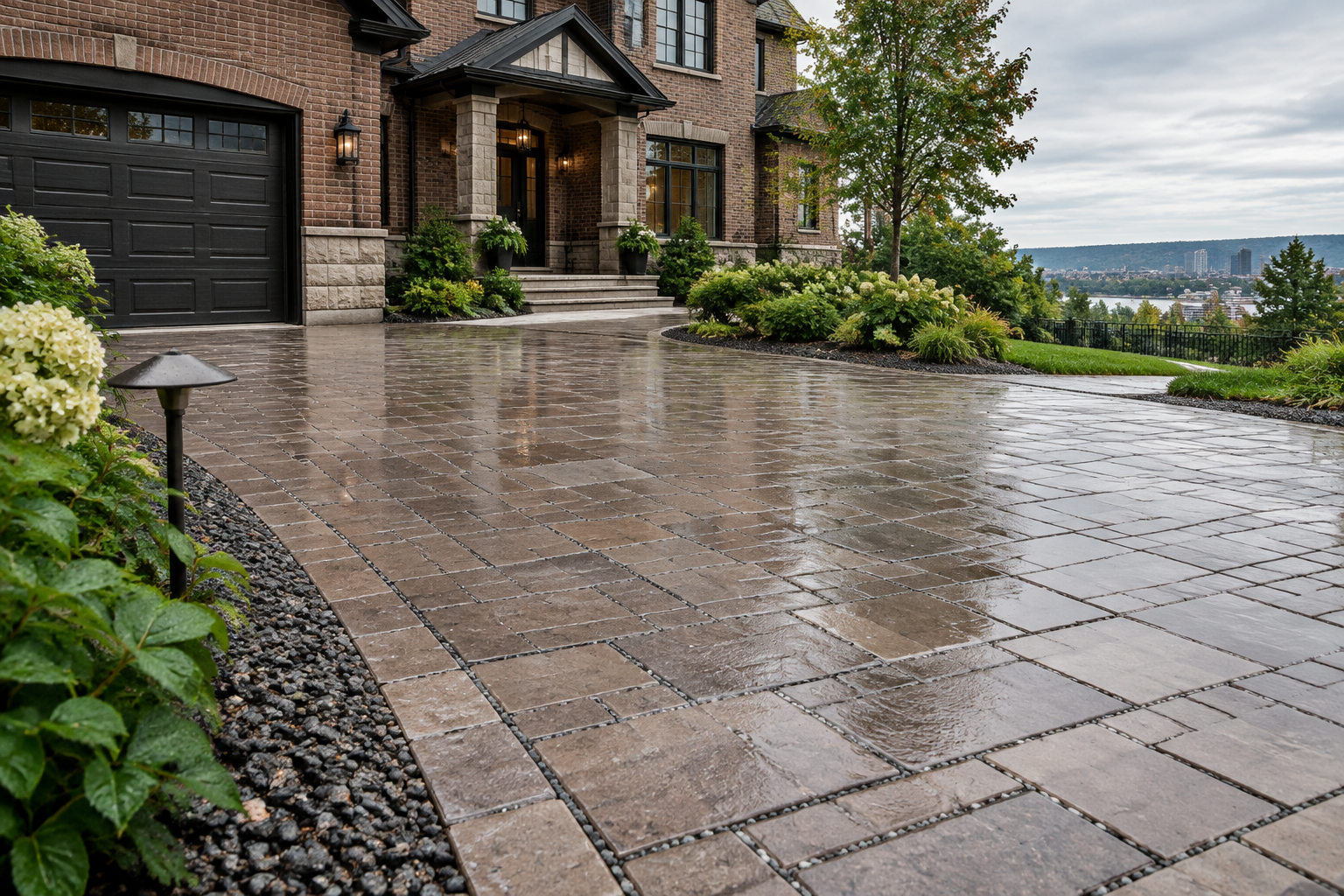
Permeable Interlock Pavers in Hamilton & Halton
Permeable paving is a water-management system beneath a finished surface. Unlike a conventional installation that sheds most rain across the top, an open-jointed surface admits water into a reservoir of clear stone. Whether that stored water can enter the native soil—or needs a controlled outlet—depends on the property.
Step 1 of 6 — Firm soil base
Permeable pavers are quoted on site. Wider joints filled with small clear chip admit water into open-graded clear-stone base layers that temporarily store it. The base is usually deeper than standard interlock; clay soils in parts of Hamilton may call for an underdrain or overflow after on-site assessment. Your exact price comes from an on-site quote.
A surface made for the way you use it
- A driveway with recurring puddles and limited options for surface drainage
- A patio receiving runoff from roofs or nearby paving
- A property where runoff should not be directed toward the house or neighbours
- A homeowner willing to keep open joints clear of accumulated sediment
Design options
See the pattern and the detail
Pick a Techo-Bloc or Unilock stone, then choose its colour, laying pattern and border. Every layout is drawn to scale from the manufacturer's real unit sizes.
This preview is drawn to scale from the manufacturer's real unit sizes, so the colour, pattern and border match what arrives on site.
Unilock · Paver
Town Hall
Timeworn clay-brick character, 4×10.
Suitable for driveways, per the manufacturer.
- Units in this pattern
- 4×10 in
- Thickness
- 70 mm
- Use
- DrivewaysRated
- Patios & walkwaysSuitable
Illustrations are drawn to scale from published unit sizes; on-screen colours and textures are approximations and vary with screen, production batch and light — we bring physical samples to your design consultation. Techo-Bloc® and Unilock® and their product names are trademarks of their respective owners; Antoine Landscape Contractors is an independent installer.
- Joint width is functional: small clean chip fills the gaps rather than polymeric sand.
- A simple running-bond layout can make the open joints readable without a busy decorative inlay.
- A restrained edge separates chip-filled paving from soil and mulch that could clog it.
- Colour and texture still matter, but the drainage design must be resolved before the surface pattern.
Plan the investment
Permeable Pavers depend on the condition, materials, access and drainage; no fixed rate applies. Your exact price comes from an on-site quote.
Request an on-site quote →What shapes the quote
- Soil infiltration, contributing runoff and the safe outlet are assessed on site.
- Reservoir depth and clear-stone quantity depend on the site and loading.
- Underdrains, overflow and downspout changes are separate design decisions.
- Access, removal and ongoing joint care affect the appropriate solution.
Built from the ground up
What's under an interlock surface
Rain soaks straight through permeable pavers into layers of stone that hold and slowly release the water.
Driveway: Typical dig: about 12–16 in below the finished surface.
- Pavers: Usually 80 mm (3⅛ in) thick for vehicle loads. Thicker units spread tire loads and resist cracking.
- Joint sand: Polymeric sand swept into every joint. Locks the pavers together and keeps out weeds and ants.
- Bedding layer: About 1 in of screeded sand. A flat, even bed the pavers are set into — never used to fix low spots.
- Granular base: 8–12 in of crushed stone, compacted in lifts. This is what carries the weight. Compacting in thin layers stops it settling later.
- Geotextile fabric: Where the soil needs it (common on Hamilton clay). Keeps the stone base from sinking into soft clay over time.
- Native soil: Excavated, levelled and compacted. A firm, properly sloped subgrade so water drains instead of pooling.
- Edge restraint: Spiked along every open edge. Holds the outer pavers so the surface can't creep apart.
Patio & walkway: Typical dig: about 9–12 in below the finished surface.
- Pavers or slabs: Typically 50–60 mm (2–2⅜ in) thick. Foot traffic needs less thickness than a driveway.
- Joint sand: Polymeric sand swept into every joint. Locks the units together and keeps out weeds and ants.
- Bedding layer: About 1 in of screeded sand. A flat, even bed the pavers are set into.
- Granular base: 6–8 in of crushed stone, compacted in lifts. Spreads the load and stops low spots forming.
- Geotextile fabric: Where the soil needs it (common on Hamilton clay). Keeps the stone base from mixing into soft clay.
- Native soil: Excavated, levelled and compacted. A firm, properly sloped subgrade.
- Edge restraint: Spiked along every open edge. Holds the outer pavers so the surface can't creep apart.
Permeable: Usually deeper than standard interlock — the stone layers also store rainwater. Depth is set by the design.
- Permeable pavers: Units with wider joints that let water through. Rain soaks in at the surface instead of running off.
- Joint aggregate: Small clear chip — not polymeric sand. Open joints keep the surface draining.
- Bedding layer: About 2 in of small clear chip. Sets the pavers while letting water pass straight through.
- Open-graded stone: Clean, washed stone with open spaces. Holds water temporarily while it soaks into the ground.
- Sub-base reservoir: Larger clean stone — depth set by design. Extra storage for heavy rain; an underdrain carries overflow away where clay drains slowly.
- Native soil: Tested and graded, left uncompacted where it should absorb water. Water infiltrates here, or drains through the underdrain on clay.
- Edge restraint: Spiked along every open edge. Holds the outer pavers so the surface can't creep apart.
Why the base matters in an Ontario winter
| Granular base | Open-graded clear stone reservoir; depth assessed on site |
|---|---|
| Paver thickness | Selected for load and open-joint assembly |
| Bedding | Suitable open-graded bedding, product-specific |
| Edge restraint | Matched to the pavement edge and adjoining material |
| Joints | Wider joints filled with small clear chip; no polymeric sand |
| Slope | Direct surface water away from the home; confirm site grades |
What happens to a raindrop?
Water enters the wider joints between suitable pavers, passes through small clear chip and moves into open-graded stone beneath. The voids between the larger stone pieces create temporary storage. From there, water may infiltrate into suitable soil or be released through a designed drain and overflow. It is not a promise that every storm vanishes instantly: available storage, rainfall intensity, native soil and outlet all matter. A downspout should never be connected without checking capacity and the safe overflow route.
Not a standard base with wider joints
A conventional compacted dense granular base contains fines and is meant to support a surface that sheds water. A permeable assembly uses open-graded clear stone in layers, generally with a deeper reservoir than standard interlock, so water can move and be held temporarily. Bedding and pavers also have to suit the system. Filling wider joints with polymeric sand would defeat the purpose. The cross-section is chosen for the expected vehicle or pedestrian load and the site's subgrade, not copied from a patio detail.
Clay changes the outlet conversation
Some Hamilton-area properties have clay-rich soil that absorbs water slowly. A permeable finish can still help with collection and temporary storage, but infiltration into clay may be insufficient for the proposed catchment. On site we assess soil, slope, available depth and where an underdrain or overflow could responsibly discharge. We do not claim that open joints alone cure wet ground. If the surrounding grade sends water toward a basement, changing the surface without fixing that path would leave the underlying risk in place.
Decide how much water arrives
A paved driveway receives its own rainfall and may also catch roof runoff, an adjacent walk or a higher lawn. Those contributing areas affect reservoir sizing and the location of inlets or a safe bypass. A patio below a downspout is a different problem from an isolated garden path. We look at where existing water travels during rain, which areas belong to the property and whether an outlet can be maintained. Water should not be rerouted onto a neighbouring lot simply because the new surface looks absorbent.
Driveway loads still count
The surface must carry vehicles if it is a driveway. Paver suitability, turning areas, base stability and edge restraint are evaluated with traffic in mind. An open-graded reservoir is not an excuse to reduce structural preparation. A narrow strip beside a conventional drive may create an awkward joint in both structure and drainage, so a partial intervention deserves a closer look. For a pedestrian patio, furniture and comfortable walking texture matter alongside infiltration. Both applications need an outlet plan for conditions that exceed storage.
When conventional interlock is better
If the property already has a clear, responsible path for surface water, standard interlock with proper grading may be the better value. It avoids the extra reservoir and the joint-cleaning commitment. The same may be true if soil and site constraints mean almost all water would have to be piped away anyway. We compare the actual drainage problem, not just the label on a paver. Regrading, moving a downspout discharge or correcting a low spot may solve a localized puddle without rebuilding an entire surface as permeable.
Keep the joints open
Leaves, driveway grit, soil and mulch can fill the openings over time. Sweep or vacuum the surface as appropriate to remove sediment; periodically top up compatible clear chip where joints have lost fill. Do not spread sand or soil across it, and keep adjacent beds from spilling fines onto the paving. If water stops entering a formerly open area, investigate clogging and surrounding drainage rather than assuming the stone reservoir has failed. The maintenance commitment should be discussed before choosing a permeable driveway or patio.
Winter treatment and spring check
Clear snow with a plastic edge or protected blade so corners are not scraped. Use traction and de-icing products only as directed by the selected paver maker; sand intended for traction can clog open joints. Frozen ground may limit infiltration, so a safe overflow remains important in thaw and rain-on-snow conditions. In spring, remove accumulated grit and inspect edges and chip levels. Avoid pressure or cleaning methods that push sediment down into the stone. Winter performance depends on the whole system and its outlet.
Rules and responsible discharge
Some municipalities and conservation authorities encourage infiltration, but that does not mean every permeable driveway is automatically approved or exempt from coverage rules. Work affecting a driveway approach, boulevard, grading or protected area may need review. Ask the municipality about the proposed footprint and stormwater routing before excavation. An underdrain needs a lawful, practical outlet; an overflow should not create a new nuisance next door. Our site visit establishes the questions and the quote rather than promising a regulatory credit or incentive.
Do I need approval?
Some municipalities and conservation authorities encourage infiltration, but site alteration, driveway, conservation and drainage rules still apply. A permeable finish does not itself authorize widening or rerouting runoff. Confirm current requirements with your municipality.
Confirm current requirements with your municipality.
From site visit to final joint
- 01
Design consult & measure
- 02
Survey, grades & approvals
- 03
Ontario One Call locates
- 04
Excavate to the right depth
- 05
Geotextile where needed; compact granular base in lifts
- 06
Bedding & screeding
- 07
Lay pavers, cut & set borders
- 08
Edge restraint & polymeric sand
- 09
Final compaction, cleanup & walkthrough
Materials we install
Techo-Bloc, Unilock, Permacon pavers and slabs, natural stone and porcelain. Product selection depends on the intended load, finish and manufacturer's installation guidance.
Keep the surface working well
- Sweep or vacuum fine sediment from open joints and top up clean chip when needed.
- Keep mulch, loose soil and traction sand off the paving; use product-approved winter care.
- Inspect the overflow, underdrain if present, and restrained edges after thaw.
Common questions answered
Permeable Pavers questions
How much do permeable pavers cost?
The system is quoted on site because excavation depth, soil, underdrain and outlet differ by property. Your exact price comes from an on-site quote.
Why use clear chip rather than polymeric sand?
Open joints carry water into the reservoir. Polymeric sand closes those pathways and is not the joint fill for this system.
Will permeable paving work on Hamilton clay?
It may need a designed underdrain or overflow if infiltration is slow. We assess the soil and discharge route on site.
Can a permeable driveway hold cars?
Yes when the selected pavers, base and edge system are designed for the vehicle loads and site conditions.
Can a roof downspout drain into it?
Only after checking the added catchment, reservoir capacity, overflow and safe routing away from the house.
How do I clean the joints?
Sweep or vacuum sediment rather than sweeping soil into the gaps; replenish compatible clean chip as needed.
Is it maintenance-free in winter?
No. Avoid sand that clogs joints, use edge-safe snow tools and follow the paver maker's de-icer guidance.
Does it remove the need for driveway approval?
No. Approach, boulevard, grading and coverage requirements still apply. Confirm current requirements with your municipality.
Complete the landscape
Driveways
Explore →Patios
Explore →Walkways
Explore →Steps & Entrances
Explore →Pool Surrounds
Explore →Natural Stone & Porcelain
Explore →Repair & Relevelling
Explore →Cleaning & Sealing
Explore →Add a fire feature
Explore →Retaining walls
Explore →Decks
Explore →Fences
Explore →Christmas lighting
Explore →Design & build
Explore →Working in Hamilton, Burlington, Oakville and Ancaster, including surrounding neighbourhoods and communities.
Tell us about your permeable pavers
Share the address, approximate dimensions and what you want to change. Your exact price comes from an on-site quote.