
 AntoineAsphalt.ca
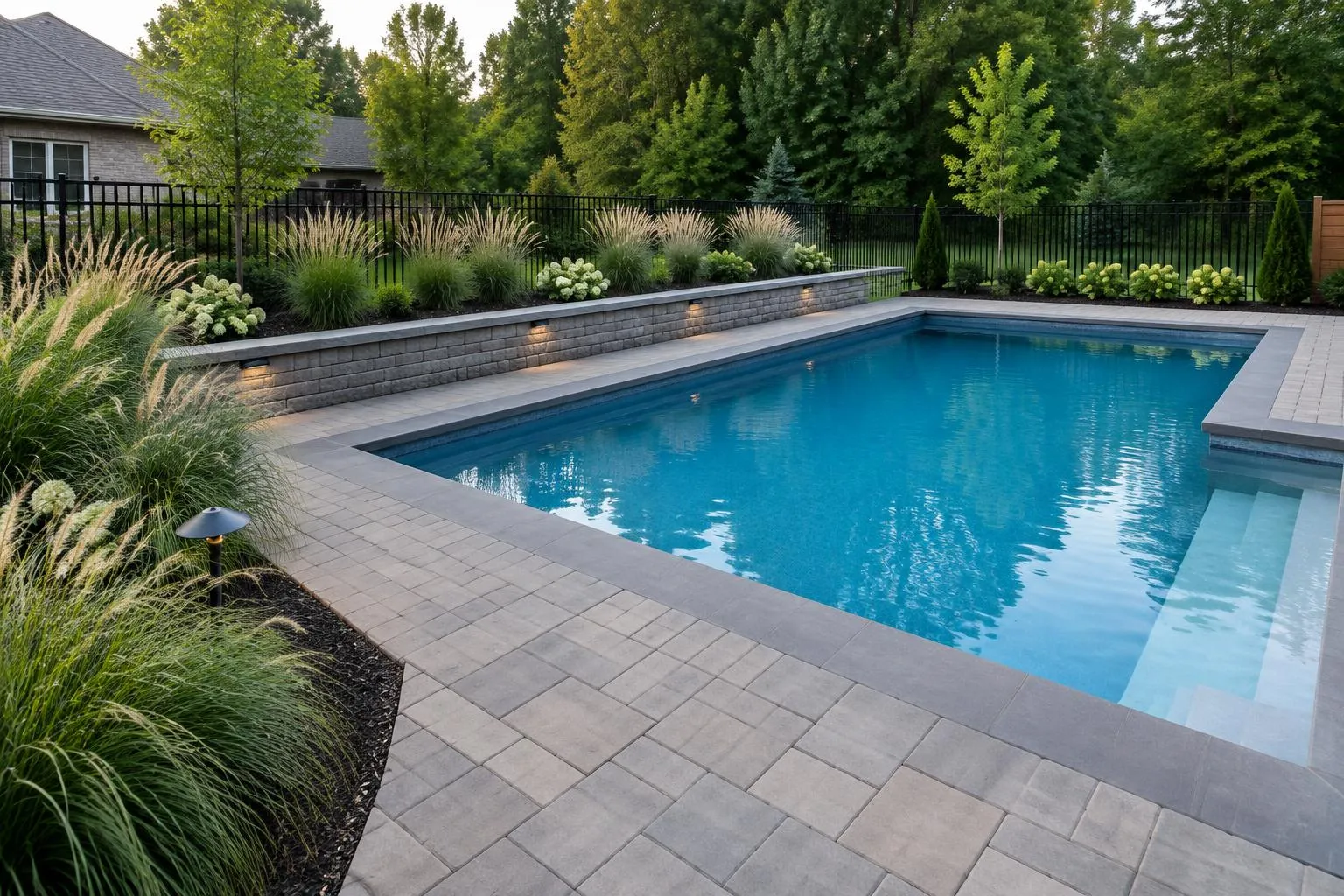
Pool surrounds · Hamilton, Burlington & Oakville
Pool Surrounds & Landscaping in Hamilton, Burlington & Oakville
Pool decks, coping, enclosure fences, retaining walls and planting, for a new pool or an existing one.
Quick answer
Interlock pool decks are a typical $25–$45 per sq ft (Allen Landscaping, Mar 2026). The ground over pool backfill almost always settles, so ICPI's technical director recommends a 4 in concrete pad over 2 in of compacted free-draining aggregate under the whole deck, sloped at least 1.5%. Latham sets a 3 ft minimum deck width. Since Oct 1, 2025 metal fences and rebar within 1.5 m of the water must be bonded, so deck and fence work are sequenced around the electrician.
- ServicePool decks, coping, enclosure fences, retaining walls and planting around pools
- AreasHamilton (incl. Ancaster, Dundas, Stoney Creek, Waterdown/Flamborough), Burlington and Oakville
- CompanyEst. 2020 · 200+ projects
- QuotesFree on-site quotes
- Phone(647) 459-7775
Top-down
Plan the whole edge
Everything required around the pool, together
How to read this: A bird's-eye view of a backyard pool. Switch layers on and off; each numbered marker matches the numbered list.
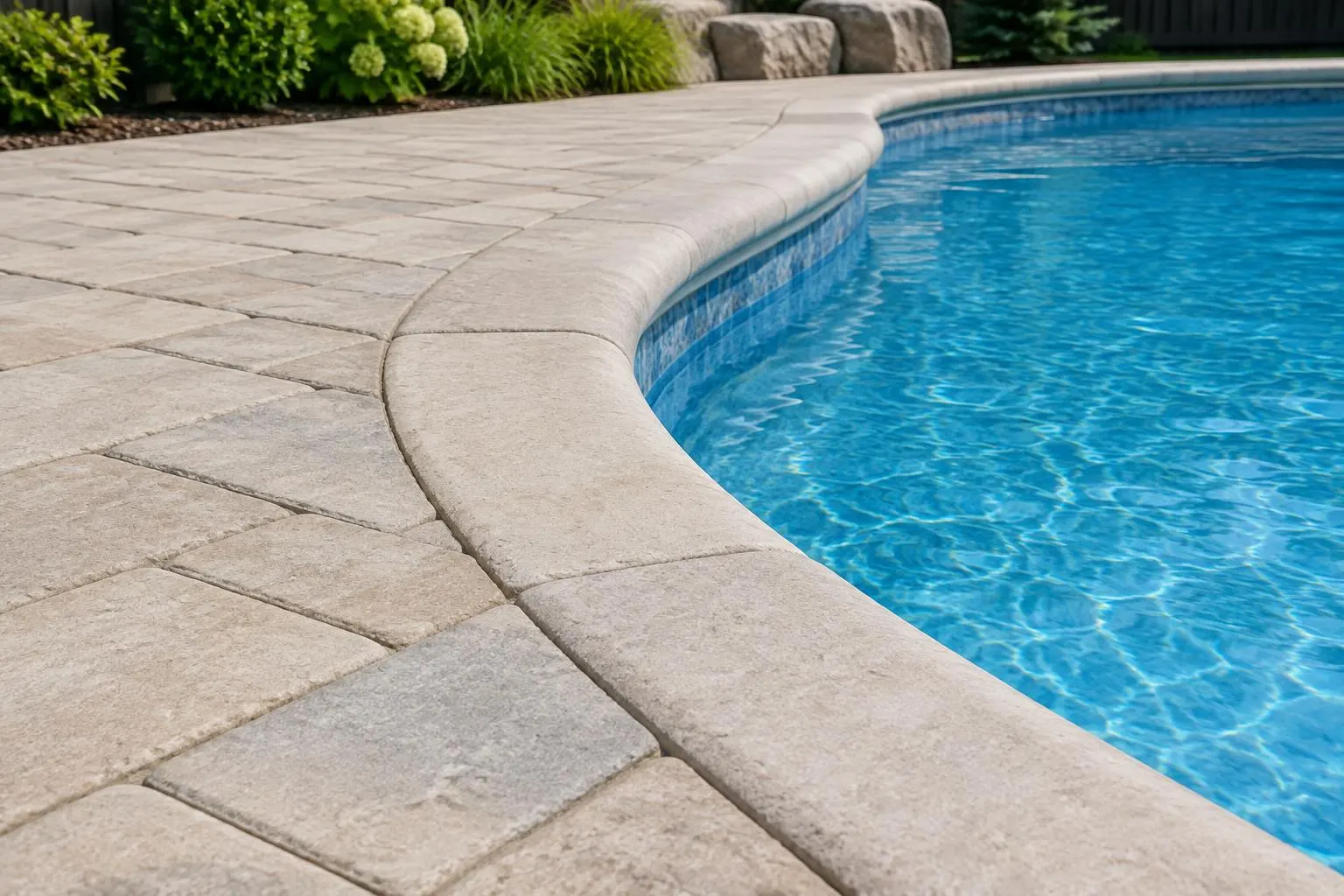
Caps the pool edge; vinyl pools use top-mount, receptor or cantilevered coping (Latham Pool Canada).
Latham sets a 3 ft (0.91 m) minimum deck width around the pool.
Hamilton: fence at least 1 m from the water and at least 1.5 m high (≥1.0 m from the inside pool wall).
Hamilton: self-closing; self-latching on the inside at ≥1.35 m; lock.
Metal fences, piping, ladders and rebar within 1.5 m of the water must be bonded (ESA Bulletin 68-8-4, May 2026).
Hamilton: pool pumps 0.6 m from side and rear lot lines (s. 4.9).
Privacy planting sits outside the fence and keeps the anti-climb strip clear; nothing may help a child climb the fence.
Keep new trees about 6 m (20 ft) back from the water (Homes & Gardens, Jun 2024).
Under the pavers
Why pool decks settle, and how to stop it
How to read this: A side view of the pool deck next to the pool wall. Pick a tab to compare pavers laid straight on backfill with pavers on a concrete sub-pad.
Pavers on compacted backfill
Pavers bedded straight onto the backfill next to the pool wall. ICPI's technical director says settlement over pool backfill "will almost always occur regardless of diligent soil and base compaction", so a dip forms beside the coping (illustrative).
- Pavers
- Backfill zone
- Undisturbed soil
- Pool wall
- Pavers on compacted backfill: Pavers bedded straight onto the backfill next to the pool wall. ICPI's technical director says settlement over pool backfill "will almost always occur regardless of diligent soil and base compaction", so a dip forms beside the coping (illustrative).
- Concrete sub-pad detail: Pavers and bedding over a 4 in concrete pad on 2 in of compacted free-draining aggregate under the whole deck, sloped at least 1.5% away from the pool (ICPI technical director).
ICPI's technical director says settlement over pool backfill "will almost always occur regardless of diligent soil and base compaction." A concrete sub-deck under patio stones is a typical $6 per sq ft (Jameson Pool & Spa, Jul 2023). No source supports a waiting period before paving over backfill, so we don't rely on one.
The edge
Coping styles
Shapes for the cap along a pool edge (coping profiles)
How to read this: Each drawing is a side view of the pool edge, cut in half, showing a different coping shape (the cap along the edge). Blue is the water.
- Bullnose
Rounded front edge; a common Ontario interlock coping profile.
- Square edge
Crisp, flat front edge for modern decks.
- Rock face
Split, textured front for a natural-stone look.
- Cantilevered poured edge
Concrete poured in foam forms over the wall; can hide an automatic cover track (Latham Pool Canada).
Vinyl pool coping systems
- Top-mount: Flat pavers or stone laid over the pool edge (Latham Pool Canada).
- Receptor: A concrete receptor coping that holds the liner (Latham Pool Canada).
- Cantilevered: Concrete poured in foam forms over the wall; can hide an automatic cover track (Latham Pool Canada).
US reference (River Pools, 2020): cantilevered concrete coping about US$6–$10 per linear ft vs paver coping US$40–$50.
Salt and frost
Choosing a deck surface for salt and freeze-thaw
| Surface | Salt water | Freeze-thaw | Heat / slip | Typical per sq ft |
|---|---|---|---|---|
| Interlock pavers | Choose low-absorption pavers (<4%) for salt pools (Allen); salt can leave residue on pavers (Unilock). | — | Light, non-slip textures stay cooler; reseal every 3–5 years (Unilock). Matte sealers for slip resistance (Allen). | $25–$45 (Allen, Mar 2026); premium $30–$35 (MoneySense, Jun 2024) |
| Porcelain | — | — | — | — |
| Imported natural stone | Seal natural-stone coping on all six sides (Litos). | — | — | $40–$50 (MoneySense, Jun 2024) |
| Flagstone on concrete | Salt attacks sealers; penetrating silane/siloxane sealers beat film-forming acrylics (Concrete Decor, 2014). | — | — | — |
| Canadian dimensional stone | Seal natural-stone coping on all six sides (Litos). | — | — | — |
| Travertine / limestone | Porous limestone and travertine are the riskiest choices for salt-water pools in freeze-thaw (our synthesis of the sources above). | Travertine can pit in freeze-thaw (Allen). | — | — |
| Composite decking | — | — | — | — |
Porous limestone and travertine are the riskiest choices for salt-water pools in freeze-thaw (our synthesis of the sources above). "—" means none of our sources covers it. Wood or composite decking at least 13 mm thick that extends 1 m can skip deck bonding (ESA Bulletin 68-8-4).
Electrical safety
Bonding comes first
The pool's bonding zone (grounding safety ring)
How to read this: A bird's-eye view of a pool. Metal inside the dashed outer line, 1.5 m from the water, must be bonded. The numbers match the list under the drawing.
- 1.5 m (5 ft) zone: connect nearby metal to the bonding wire
- 1 m (3.3 ft) deck grid zone
- Pool water
- Metal fence post
- Ladder
- Rebar
- Anything metal within 1.5 m (5 ft) of the water — fence posts, ladders, rebar, pipes — gets connected to the bonding wire.
- Concrete or paver decks get a copper grid underneath; a wood or composite deck may not need one.
- A licensed electrician does this and ESA inspects it before the deck goes down.
Decks with encapsulated or fibreglass rebar need a bare No. 6 AWG copper grid at 300 mm mesh, extending 1 m from the shell and 100–150 mm below grade; deck bonding can be skipped where wood or composite decking at least 13 mm thick extends 1 m. ESA Bulletin 68-8-4.
Green edges
Planting around a pool
- Keep new trees about 20 ft from the water.
- Avoid fruit trees, running bamboo, mint and bee magnets like lavender (Homes & Gardens, Jun 2024).
- Hamilton is USDA zone 6b.
- Hedges can't form part of a Hamilton enclosure, and nothing may help a child climb the fence, so privacy planting supplements the fence and stays out of the anti-climb zone.
Grade
Sloped yards
Under the Ontario Building Code, a retaining wall over 1 m of exposed height next to public property or building access is a designated structure. In Hamilton, a retaining wall over 0.5 m triggers a Site Alteration Permit. Retaining walls →
Typical market ranges
Typical ranges
| Item | Per sq ft | Source |
|---|---|---|
| Interlock pool deck | $25–$45 | Allen Landscaping, Mar 2026 |
| Interlock patio | $20–$60+ | Creative Concepts, Jun 2026 |
| Premium interlock | $30–$35 | MoneySense, Jun 2024 |
| Imported natural stone | $40–$50 | MoneySense, Jun 2024 |
| Concrete sub-deck under patio stones | $6 | Jameson Pool & Spa, Jul 2023 |
Typical market ranges from the named source and date. Your exact price comes from an on-site quote.
One plan
Pairs well with
Interlock pool surrounds
Pavers and coping on a prepared base.
Plan together →Pool fences
Enclosures planned around your city's rules.
Plan together →Decks
Raised decks and stairs down to the pool.
Plan together →Retaining walls
Level a sloped yard for the pool and deck.
Plan together →Garden beds & planting
Privacy planting outside the fence.
Plan together →Common questions answered
Straight answers
Pool surrounds & landscaping FAQ
How much does an interlock pool deck cost?
Interlock pool decks run a typical $25–$45 per sq ft (Allen Landscaping, Mar 2026). Premium interlock is $30–$35 and imported natural stone $40–$50 per sq ft (MoneySense, Jun 2024), and a concrete sub-deck under patio stones adds about $6 per sq ft (Jameson Pool & Spa, Jul 2023). These are typical market ranges; your exact price comes from an on-site quote.
Why do pool decks sink next to the pool?
The ground over pool backfill settles. ICPI's technical director says settlement over backfill "will almost always occur regardless of diligent soil and base compaction." The fix is structural: a 4 in concrete pad over 2 in of compacted free-draining aggregate under the whole deck, sloped at least 1.5% away from the pool, with the pavers bedded on top.
Should I wait a year before paving over pool backfill?
No source we found supports a waiting period before paving over pool backfill, so we don't rely on one. ICPI's guidance is to build a deck that tolerates settlement instead: a 4 in concrete pad over 2 in of compacted free-draining aggregate under the whole deck, sloped at least 1.5%, with the pavers bedded on top.
How wide should a pool deck be?
Latham, a pool manufacturer, sets a 3 ft minimum deck width around the pool. Many yards need more room for loungers, the gate swing and the walk to the house. The enclosure fence also has to sit a set distance from the water: at least 1.0 m in Hamilton, 1.2 m in Burlington and 0.91 m in Oakville.
Why does bonding affect my deck and fence schedule?
OESC Rule 68-058 applies to every ESA notification filed on or after Oct 1, 2025, and ESA Bulletin 68-8-4 (May 2026) says metal fences, piping, ladders and rebar within 1.5 m of the water must be bonded. Some decks also need a copper grid below grade. So the paver base, deck pour and metal fence posts are scheduled around the electrician's bonding inspection.
What deck surface is best for a salt-water pool?
Low-absorption pavers, under 4% absorption, are recommended for salt pools, with matte sealers for slip resistance (Allen Landscaping, Mar 2026). Salt attacks sealers, and penetrating silane or siloxane sealers outlast film-forming acrylics (Concrete Decor, 2014). In our synthesis of these sources, porous limestone and travertine are the riskiest choices for salt-water pools in freeze-thaw.
What should I plant around a pool?
Keep new trees about 20 ft from the water, and avoid fruit trees, running bamboo, mint and bee magnets like lavender (Homes & Gardens, Jun 2024). Hamilton is USDA zone 6b. Plant outside the fence and keep the anti-climb zone clear, because nothing may help a child climb the fence and hedges can't form part of a Hamilton enclosure.
Do I need a permit for a retaining wall beside my pool?
It depends on height and location. Under the Ontario Building Code, a retaining wall over 1 m of exposed height next to public property or building access is a designated structure. In Hamilton, a retaining wall over 0.5 m is one of the triggers for a Site Alteration Permit. Confirm current rules with your municipality before building.
Start with the yard
Tell us about your pool surrounds & landscaping project.
Share your city, timing and side-yard access. We'll arrange a free on-site consultation.