
 AntoineAsphalt.ca
Paver design guide
Paver Patterns and Styles: Choosing the Right Look
Herringbone — at 45° or 90° — is the go-to pattern for driveways because it interlocks well under turning tires. Running bond and large-format slabs suit patios and walkways, basketweave adds a traditional look, and random multi-size patterns feel more natural. Soldier or sailor borders frame the field and help hold the edge.
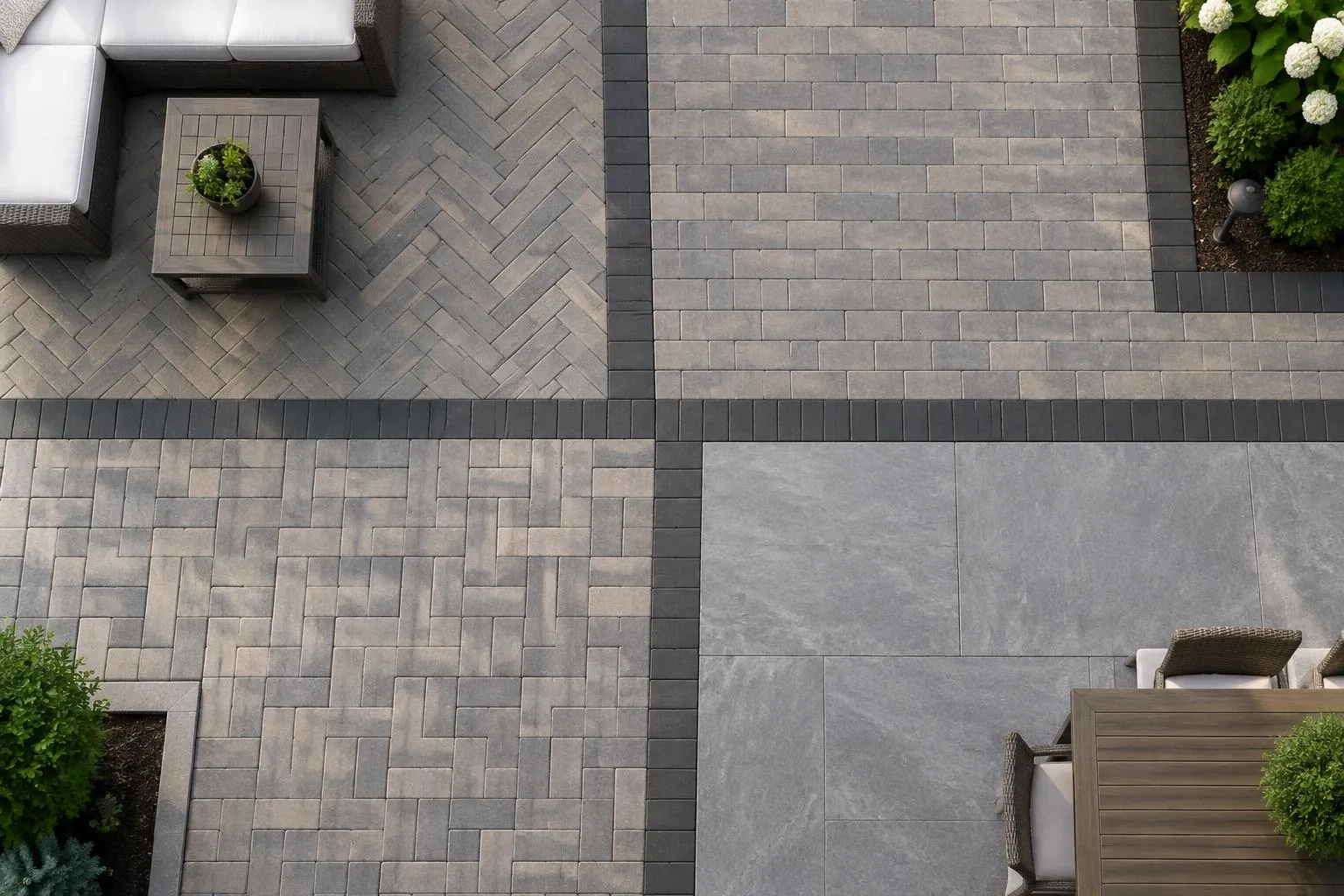
Herringbone — at 45° or 90° — is the go-to pattern for driveways because it interlocks well under turning tires. Running bond and large-format slabs suit patios and walkways, basketweave adds a traditional look, and random multi-size patterns feel more natural. Soldier or sailor borders frame the field and help hold the edge.
Key takeaways
- Pattern affects both look and strength; herringbone is the usual choice where cars turn.
- Borders frame the design and give the edge a clean, stable finish.
- Colour and texture should relate to the house, not just the paver sample.
- Try combinations in the visualizer before the site visit.
Why does pattern matter?
A paver pattern is more than decoration. The way units are arranged changes how they share loads, how they resist shifting when a car turns, how much cutting is needed at the edges and how the space feels. The same paver can look formal, relaxed, traditional or modern depending on how it is laid. That is why we treat pattern as a design and structural decision at the same time.
What are the main paver patterns?
These are the patterns we are asked about most. Each has a natural home.
| Pattern | Look | Strength under vehicles | Best for |
|---|---|---|---|
| Herringbone 45° | Dynamic zig-zag running diagonally | Very good — units lock in several directions | Driveways, busy entrances |
| Herringbone 90° | Zig-zag aligned with the edges | Very good | Driveways, long walkways |
| Running bond | Clean offset rows, like brick | Fair — better laid across the direction of travel | Walkways, patios, narrow spaces |
| Basketweave | Traditional, woven look | Lower — best kept to pedestrian areas | Patios, garden paths, heritage homes |
| Random multi-size | Natural, stone-like variety | Depends on the product and base | Patios, walkways, relaxed spaces |
| Large-format slab | Modern, calm, few joints | Generally pedestrian unless the product is rated for vehicles | Patios, entrances, pool surrounds |
Why is herringbone recommended for driveways?
In herringbone, each paver is set at a right angle to its neighbours, so no joint runs in a straight line for long. When a tire turns on the surface, the load is shared across many units instead of pushing a row sideways. Laid at 45° to the edge, it reads as more dynamic and hides small alignment differences; at 90°, it lines up with the house and garage for a slightly more formal look. Both need careful edge cuts and a solid border to finish well.
Pattern works together with the base, paver thickness and edge restraint. Herringbone on a thin base will still rut; the pattern helps, but it is not a substitute for good preparation.
What kind of border should I choose?
A soldier course sets pavers side by side with their long edges facing the field, like soldiers in a row. A sailor course lays them end to end along the edge, giving a thinner line. A contrasting border in a darker or lighter colour frames the space and can tie the driveway to a walkway or step. Borders also give a clean edge for the cut pavers of the main field and sit against the edge restraint.
Double borders, inlays and banding across a large field add interest and help break up big areas. They also add cutting time, which shows up in the price.
How do I choose colour and texture?
Start with the house. Pull colour from the brick, stone, roof or trim rather than choosing a paver in isolation. Blended colours hide dirt and tire marks better than solid tones. Charcoal and very dark colours look sharp but show dust and salt residue; light colours stay cooler in the sun, which matters around pools. Texture ranges from smooth and modern to tumbled and aged; smoother surfaces are easier to shovel and clean, while textured ones can add grip.
Look at samples outdoors, wet and dry, at different times of day. A colour that looks warm in a display can read cool on a north-facing driveway.
Can I preview patterns and borders?
Use the visualizer to combine patterns, borders and colour families. It is a design aid, not a product catalogue, and final samples are chosen together on site.
Which patterns suit driveways, patios and walkways?
A rule of thumb for each area:
- Driveways: herringbone 45° or 90° with a soldier border; thicker vehicle-rated pavers
- Patios: large-format slabs, random multi-size or running bond; borders to define dining or lounge zones
- Walkways: running bond across the path or herringbone for longer runs; a sailor or soldier edge
- Steps and entrances: match or contrast treads with the walkway; keep joints aligned for a tidy look
- Pool surrounds: lighter, textured surfaces with suitable slip resistance per the maker's specs
Can I mix patterns on one property?
Yes, and it often works well. A herringbone driveway can transition to a large-format walkway and patio, with a shared border colour tying them together. The key is to keep the palette consistent and to use borders or bands at the transitions so the change looks deliberate. Too many patterns in a small area can feel busy, so we usually suggest one feature pattern and one supporting pattern.
Does the pattern change the price?
Yes, modestly. More complex patterns, borders and curves mean more cutting and layout time than a straight running bond. For planning, typical Ontario installed ranges (2026) are $25–$45 per sq ft for driveways and patios and $20–$35 for walkways; complex designs tend to sit higher in the range. Your exact price comes from an on-site quote.
How do edges, cuts and transitions affect the finished look?
The edges are where a paving job reveals its quality. Clean, straight cuts, borders that frame the field, and careful transitions to steps, doors, walls and lawn make even a simple pattern look deliberate. Small slivers of cut pavers at an edge are more likely to loosen, so layout is usually planned to avoid them.
Curves need extra attention. A border that follows a curve smoothly takes more cutting time, but it is often what makes a curved walkway or patio feel finished.
How does the size of the space affect the pattern choice?
Scale matters. Large slabs can make a small patio feel calmer and more spacious because there are fewer joints to draw the eye, while small units in a busy pattern can make a large driveway feel more textured and less flat. On narrow side-yard paths, a simple running bond laid across the path is often easier to cut and looks tidier than a complex pattern squeezed into a tight space.
How should I compare samples before deciding?
Bring a few samples home and set them on the ground where the paving will go. Look at them in the morning and late afternoon, wet from a hose and dry, and next to your brick or siding. Photograph them from the street as well as up close. The combination that still looks right from the sidewalk is usually the one you will be happiest with.
If you are torn between two colours, a blend or a border in the second colour can be a good compromise.
How does lighting change the look of a pattern?
Low-angle landscape lighting brings out texture and joint lines, so a pattern that seems subtle in daylight can look quite different at night. Step lights and wall lights near a patio highlight the paver surface, while path lights along a walkway emphasise the border. If you plan to add lighting, it is worth thinking about it while choosing the pattern, and running conduit before the base goes down.
Will a pattern or colour date quickly?
Trends come and go, but some choices age better than others. Simple patterns, natural colour blends and borders that relate to the house tend to stay attractive for many years. Very strong contrasts or highly fashionable colours can feel dated sooner. If you want something bold, consider using it in a smaller area, such as an inlay or border, where it adds character without dominating the whole property.
Frequently asked questions
What is the strongest paver pattern for a driveway?
Herringbone, at 45° or 90°, is generally recommended for driveways because the units lock together in several directions under turning tires.
Is running bond OK for a driveway?
It can be used, ideally laid across the direction of travel, but herringbone is usually the better choice where cars turn.
What is the difference between a soldier and sailor border?
A soldier course places pavers side by side facing the field; a sailor course lays them end to end, giving a thinner line.
Can large-format slabs be used on a driveway?
Generally not, unless the product is rated for vehicles. Large slabs are usually a patio, entrance or pool surround choice.
Which colours hide dirt best?
Blended colours usually hide dirt, tire marks and salt residue better than solid very dark or very light tones.
Do complex patterns cost more?
Usually a little, because borders, curves and herringbone need more cutting and layout time than simple patterns.
Which paver brands can I choose from?
We install Techo-Bloc, Unilock and Permacon pavers and slabs, as well as natural stone and porcelain.
Related interlock information
From guide to site plan
Get an on-site interlock quote
Call (647) 459-7775 or send the essentials. Your exact price comes from an on-site quote.