
 AntoineAsphalt.ca
Deck footing guide
Helical Piles vs Concrete Footings for Decks
Deck footings in Hamilton and Halton must bear below frost depth — about 1.2 m / 4 ft — so the deck doesn't heave. Concrete piers are the familiar, widely accepted choice, while helical piles screw in with less digging and can be loaded right away. The right one depends on soil, access and deck design.
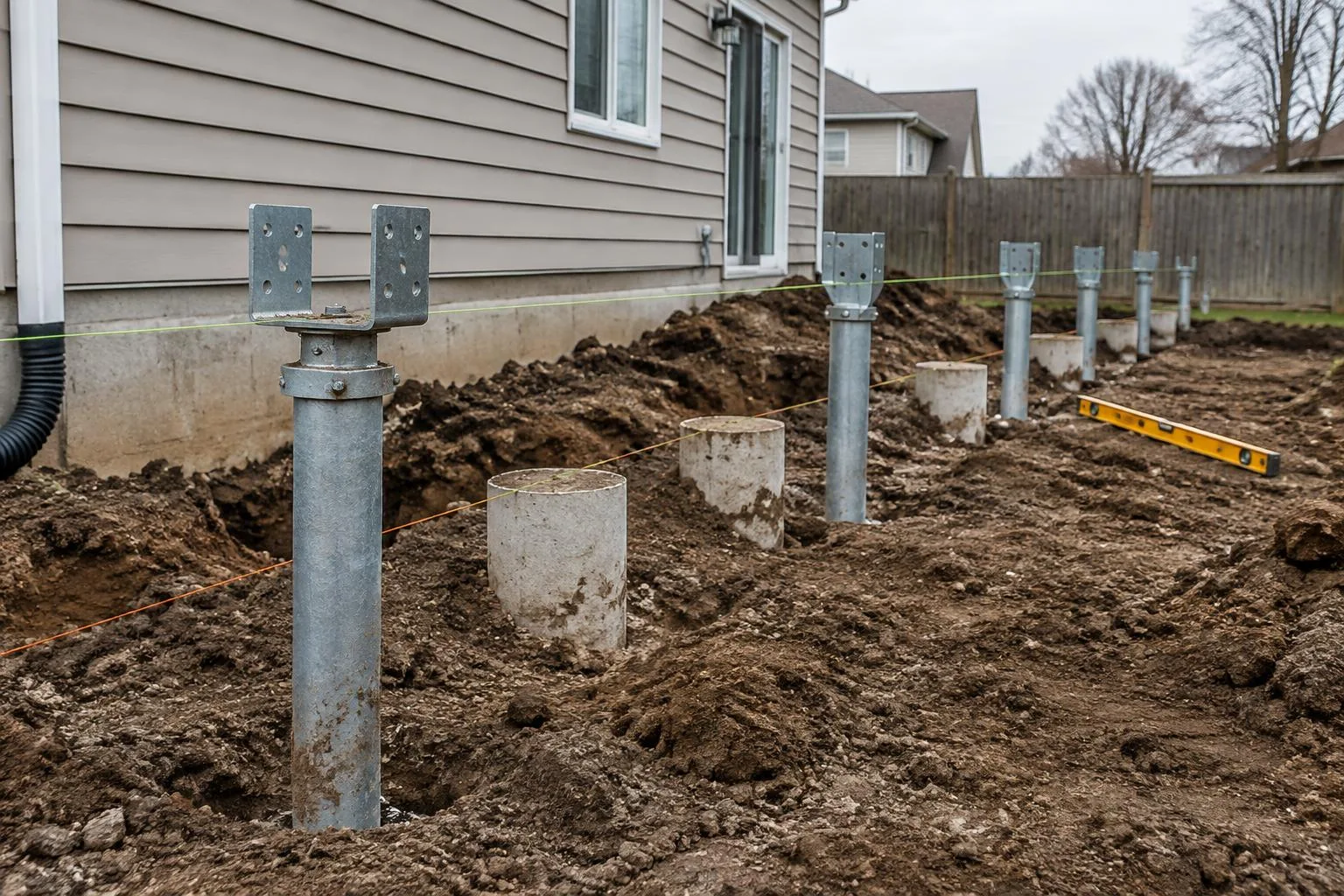
Deck footings in Hamilton and Halton must bear below frost depth — about 1.2 m / 4 ft — so the deck doesn't heave. Concrete piers are the familiar, widely accepted choice, while helical piles screw in with less digging and can be loaded right away. The right one depends on soil, access and deck design.
Why do deck footings need to go below frost depth?
Frost depth here is about 1.2 m / 4 ft. Soil above that line can freeze, expand and lift anything resting on it, then settle when it thaws. A footing that bears below frost stays put, which keeps the deck level, protects the ledger connection and stops doors and stairs from shifting out of line.
How are concrete pier footings installed?
Holes are dug or augered below frost depth, a tube form (often called a sonotube) is set, often on a wider base, and concrete is poured with a post bracket set at the top. The concrete needs time to cure before framing loads go on.
- Well understood by inspectors and widely accepted
- Needs excavation, spoil removal and concrete delivery or mixing
- Cure time before the frame can be loaded
- Hand-digging in tight yards adds labour
How are helical piles installed?
A helical pile is a steel shaft with helix plates that is screwed into the ground with a hydraulic drive head until it reaches depth and the required resistance. A bracket on top receives the beam or post.
- Little excavation and minimal spoil
- Can typically be loaded right after installation
- Installation torque helps confirm bearing
- Needs equipment access and specialized installers
Which is better: helical piles or concrete footings?
Neither is best for every deck. The table compares them in relative terms; exact costs depend on the number of footings, depth, soil and access and are set in the on-site quote.
| Factor | Concrete piers | Helical piles |
|---|---|---|
| Relative cost | Often lower for a few accessible footings | Often higher per footing; can offset labour on difficult sites |
| Install speed | Slower — dig, form, pour, cure | Faster — install and load |
| Yard disturbance | More digging and spoil | Minimal |
| Tight access | Can be hand-dug | Needs room for drive equipment |
| Wet or clay soils | Holes can cave or fill with water | Handles these conditions well when designed for them |
| Inspection | Hole depth checked before the pour | Depth and torque recorded |
Do clay soils in Hamilton change the choice?
Clay is common in parts of Hamilton, including areas of Stoney Creek and Binbrook. Clay holds water and can make open holes messy or unstable, which is one reason helical piles are increasingly used on these lots. Concrete piers still work well when holes are dug and poured promptly and bear on suitable soil below frost.
Can I use deck blocks instead of footings?
Deck blocks and other surface footings sit on or near the surface, above frost depth. They can suit some low, freestanding platforms, but they can move with frost, and they are not appropriate for attached decks or raised decks. Whatever footing is used, the deck still has to meet the Ontario Building Code. Confirm current requirements with your municipality before building.
When does each footing type make sense?
We choose the footing after seeing the site.
- Concrete piers: accessible yards, a modest number of footings, stable soil
- Helical piles: wet or clay soils, finished landscaping to protect, fast schedules, additions near existing structures
- Either: must bear below frost depth and match the permit drawings
- Neither: deck blocks for an attached or raised deck
Frequently asked questions
How deep do deck footings need to be in Hamilton?
Below frost depth, which is about 1.2 m / 4 ft here.
Are helical piles more expensive than concrete?
Often per footing, but they can reduce digging, disposal and cure time. The comparison depends on soil, access and the number of footings, so it is set in the on-site quote.
Are helical piles accepted for deck permits?
Helical piles are commonly used for decks. The footing design is shown on the permit drawings for the municipality to review.
Can I build a deck on deck blocks?
Surface blocks can suit some low, freestanding platforms but can move with frost and are not appropriate for attached or raised decks.
Can I build on the footings from my old deck?
Only if they are confirmed to be below frost, sized for the new deck and in the right locations. Most rebuilds need new footings.
Do I need to call before installing footings?
Yes. Contact Ontario One Call (1-800-400-2255) for utility locates before any digging or pile installation.
Related deck information
From guide to site plan
Get an on-site deck quote
Call (647) 459-7775 or send the essentials. Your exact price comes from an on-site quote.